

























ICYMI: From Rock Star to Vibe Coder- What L&D Can Learn About Building with AI
May 7, 2026 · 5 min read · By Klil Nevo
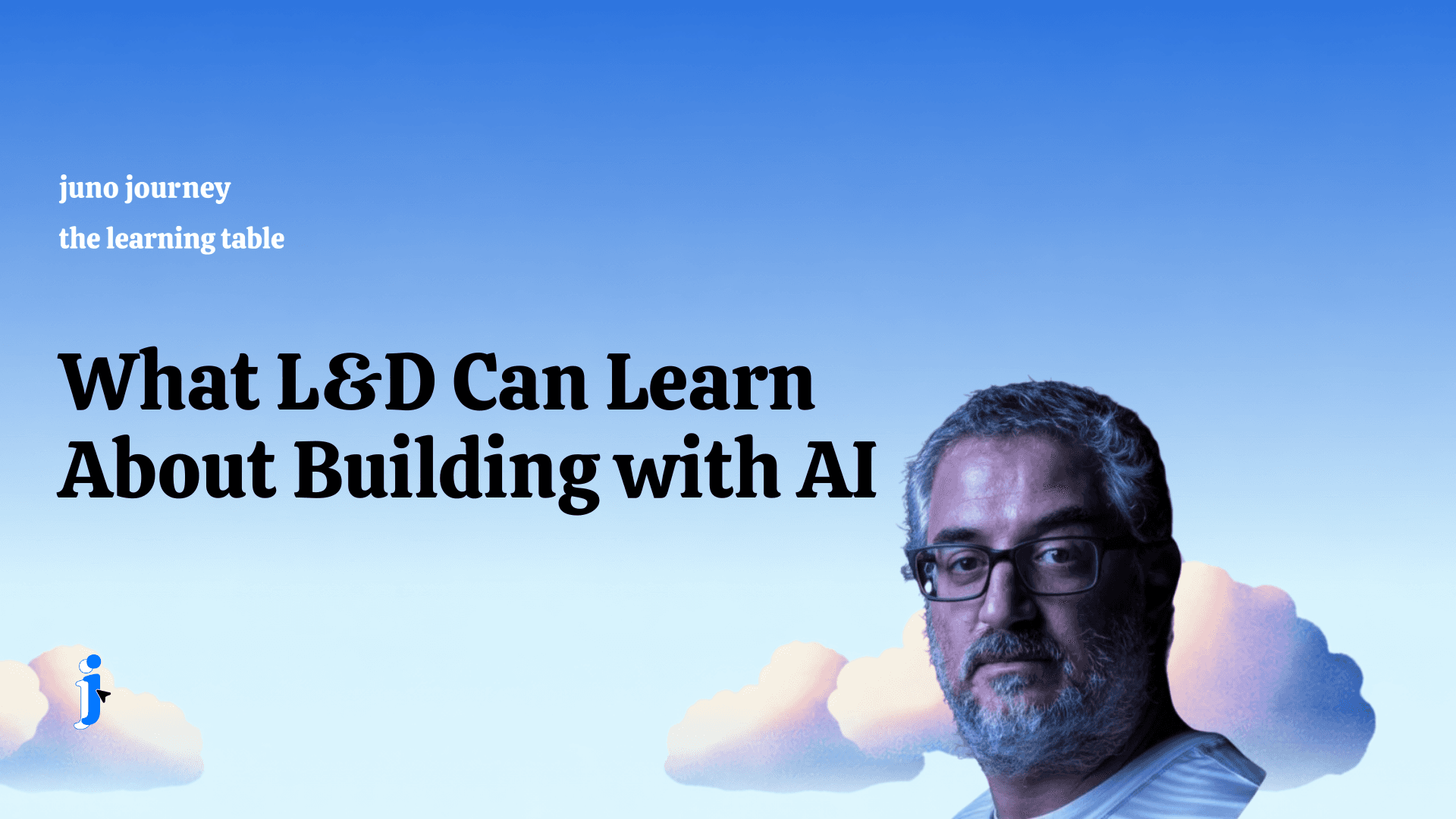
The playbook series
May 6th 2026 | Hosted by Klil Nevo: The Learning Table & Juno Journey
Expert: Matthew Donner | Intuit
What happens when an L&D leader decides they’re done waiting for permission… and starts building?
In our latest The Playbook session by The Learning Table community and Juno Journey, we hosted Matthew Donner for one of the most honest, practical, and energizing conversations we’ve had about AI so far.
Matt’s story is not the typical “AI expert” story.
He spent over 20 years building music production programs, writing books, producing game audio for titles like Halo and God of War, and teaching thousands of students around the world.
And then AI arrived.
Instead of treating it as another tool to “learn eventually,” Matt decided he wasn’t going to miss this wave the way he felt he missed the early internet era.
So he did something most people in L&D still think is reserved for engineers:
He started building.
The Shift: From Consuming AI to Creating With It
One of the strongest ideas from the session was this: “You can now build at the speed of conversation.”
Through conversations with AI tools, experimentation, failure, iteration, and persistence, Matt built a fully functioning AI-powered deck creation workflow, despite never having formally coded before.
The workflow started with a real business pain point:
A business development leader told him:
“I just don’t want to make decks anymore.”
Instead of solving for “better prompts,” Matt solved for outcomes.
He built an AI-powered presentation workflow that:
- Takes a simple prompt and raw information
- Generates a narrative
- Converts that narrative into intelligently structured slides
- Maps content to the right slide layouts
- Applies company branding automatically
- Creates speaker notes from the narrative itself
All orchestrated through multiple AI “agents” working together.
AI Didn’t Remove the Human. It Amplified It.
One of the most important themes in the conversation was that AI is not replacing creativity or strategic thinking.
It’s removing friction.
Matt repeatedly emphasized that the goal is not to hand everything over to AI blindly, but to stay deeply involved in shaping outcomes, narrative, tone, structure, and experience.
The real unlock isn’t automation alone.
It’s that AI now enables:
- Faster experimentation
- Faster learning loops
- Faster execution
- More accessible creation
- More scalable expertise
And for L&D specifically, this changes the game completely.
“Information Is Not Knowledge”
One of the standout moments of the session came when Matt challenged a core assumption many organizations still operate under:
“Information is not knowledge. Knowledge is what you can do based on what you know.”
For years, organizations believed that making content accessible was enough.
Videos.
Courses.
Knowledge bases.
MOOCs.
Documentation.
But access to information is never guaranteed capability.
AI changes that dynamic because learning can now happen interactively — through conversation, feedback, iteration, and personalized guidance.
This connects directly to a bigger shift we constantly discuss at Juno Journey:
The future is not content-driven learning.
It’s capability-driven workforce readiness.
The Three Roads to the Future
Matt introduced a framework that deeply resonated with the audience: “The Three Roads to the Future.”
Road 1: Stay Exactly the Same
Keep doing what you’ve always done.
Safe.
Predictable.
But stagnant.
Road 2: Follow the Crowd
Use AI the same way everyone else does.
Repeat the same prompts.
Chase productivity hacks.
Blend into the noise.
Road 3: Build Something New
Experiment.
Fail.
Create.
Learn publicly.
Figure things out while moving.
That third road is uncomfortable.
But it’s also where differentiation happens.
And honestly? That’s where most People teams will need to operate moving forward.
Because the organizations that win won’t just “use AI tools.”
They’ll redesign how work, learning, enablement, onboarding, and capability-building actually happen.
The Real Lesson for L&D Leaders
Interestingly, one of the final audience questions had nothing to do with coding.
A participant asked about the constant struggle of being treated as reactive content creators instead of strategic performance partners.
Matt’s answer hit a nerve for many people in the room.
He explained that most organizations still bring L&D in too late — after decisions are already made — expecting training to simply “staple onto” initiatives.
His advice?
Start shifting conversations from: “We need training.”
To: “What outcome are we actually trying to achieve?”
That mindset shift changes everything.
Because in the AI era, content production is becoming commoditized very quickly.
Strategic thinking, systems thinking, workflow redesign, capability mapping, and behavior change?
Those are becoming dramatically more valuable.
Final Thoughts: Start Before You Feel Ready
Matt closed the session with six simple but powerful takeaways:
- Just start
- Ask AI specific questions
- Don’t wait for permission
- Save your work constantly
- Expect failure
- Don’t stop experimenting
And honestly, that may be the biggest lesson of all.
Most people are still waiting to “become experts” before they build.
But the people moving fastest right now are learning by doing.
Not perfectly.
Not elegantly.
But consistently.
And maybe that’s exactly what this moment requires from all of us.