

























ICYMI: Role-specific Onboarding design
Mar 19, 2026 · 8 min read · By Klil Nevo
The playbook series
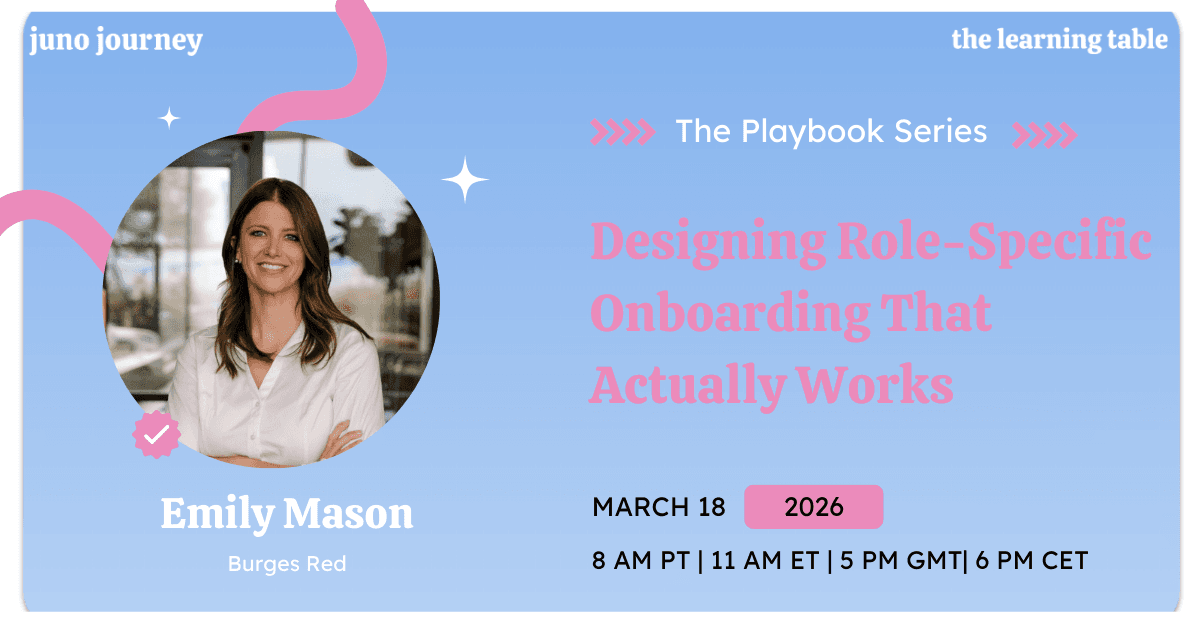
March 18th 2026 | Hosted by The Learning Table & Juno Journey
Led by: Emily Mason | Burges Red
ICYMI: What Role-Specific Onboarding That Actually Works Looks Like
For all the time, budget, and effort organizations invest in onboarding, too many new hires still start the same way: unclear on expectations, unsure where to focus, and left to piece things together on their own.
That was the heart of our recent Learning Table session with Emily Mason, Founder of BurgessRed, where we explored what it really takes to design onboarding that goes beyond orientation and actually prepares people to perform.
Because the truth is, most companies do not have an onboarding problem.
They have a readiness problem.
And the gap usually starts here: onboarding is often designed around information transfer, while success at work depends on clarity, practice, feedback, and role-specific execution.
Emily brought years of hands-on experience, practical frameworks, and real talk from the field to unpack what separates onboarding that feels good from onboarding that actually works.
Orientation is not onboarding
One of the clearest points from the session was this:
Orientation is not onboarding.
Most organizations have some form of orientation:
- benefits enrollment
- systems access
- policies
- introductions
- logistics
And all of that matters. It is necessary. But it is not enough.
Orientation helps people enter the company.
Onboarding should help them succeed in the role.
That means role-specific onboarding has to answer very different questions:
- What does success look like in this job?
- What should this person be able to do by 30, 60, or 90 days?
- What skills, behaviors, and responsibilities actually define readiness here?
As Emily put it, too many companies deliver orientation “plus a whole lot of hope.”
That hope is what leaves new hires guessing.
The real goal is capability, not completion
A major theme throughout the conversation was the difference between checking boxes and building competence.
Too often, onboarding is measured by:
- tasks completed
- content consumed
- forms signed
- modules finished
But none of those things proves that someone is actually ready to perform.
Completion does not equal competence.
A new hire may finish every module assigned to them and still have no confidence in what the role requires, how success is measured, or how to actually do the work.
That is why Emily reframed onboarding as a capability-building process.
The goal is not just to expose people to information.
The goal is to prepare them to perform.
That requires a stronger mix of:
- formal learning
- experiential learning
- on-the-job application
If onboarding does not include opportunities to practice, apply, and receive feedback in safe and relevant ways, it will struggle to move the needle on readiness.
Great onboarding removes guesswork
One of the strongest examples from the session came from a participant who described a past onboarding experience that had almost no structure at all. There was no clear roadmap, no real guidance, and no understanding of who to talk to, why, or how to get work done.
It took weeks just to understand the role.
That kind of experience is more common than many companies want to admit.
And it is costly.
When people do not know:
- What is expected of them
- Who they should learn from
- How different stakeholders connect
- What good performance looks like
They are forced to build the map themselves while already under pressure to ramp.
Great onboarding removes that burden.
It creates clarity early and intentionally:
- Why are you meeting with someone
- What you are expected to learn from them
- How does it connect to your responsibilities
- What success should look like over time
That kind of specificity is what turns onboarding from a passive experience into an actual readiness journey.
Specificity is what makes onboarding useful
One of Emily’s most practical principles was simple but powerful:
Be extremely specific.
Not:
- “Meet with Jim”
- “Review this system.”
- “Log in to the platform.”
But:
- “Meet with Jim to understand X so you can do Y.”
- “Pull this report and share 2–3 insights with your manager.”
- “Observe this workflow, then explain how it connects to your role.”
That difference matters.
Specificity makes onboarding more useful for the learner and more meaningful for the manager. It turns passive activities into performance-oriented learning moments.
It also respects the time of the people supporting onboarding. When experienced employees are brought in without a clear purpose, their time gets wasted too. But when the interaction is intentional, everyone benefits.
This was one of the strongest reminders from the conversation: onboarding should not just tell people what to do. It should make clear why it matters.
Milestones and checkpoints matter more than most teams realize
Another core takeaway was the importance of milestones and checkpoints.
New hires want clarity. They want to know:
- Am I doing well?
- Am I on track?
- What does success look like right now?
Without defined checkpoints, managers often cannot answer those questions with confidence.
But milestones do more than create reassurance. They create visibility.
They help teams assess:
- whether someone is learning at the right pace
- whether they can apply what they learned
- where support is needed
- whether the role and the person are actually a fit
Emily shared an important and often overlooked point here: strong checkpoints are not only good for ramp and confidence. They also help companies identify misalignment earlier.
When organizations wait too long to define expectations and measure progress, it can take months before they realize someone is struggling in the role. By then, the cost is much higher for everyone involved.
Effective onboarding makes progress visible early.
Managers cannot be an afterthought
If there was one thread that kept resurfacing, it was this:
Managers are essential to onboarding success.
Not at the end.
Not only for a baton pass.
From the beginning.
Managers should have visibility into the full journey and understand:
- What the new hire is learning
- What milestones matter
- When to step in
- Where coaching is needed
They should not be guessing either.
Emily emphasized that managers need enablement just as much as new hires do. They need structure, clarity, and nudges. Especially in organizations where hiring occurs in waves or is inconsistent, managers will not remember every onboarding expectation on their own.
That is why great onboarding is not built only for the learner.
It is built for the manager, too.
Automation should support clarity, not complexity
The session also explored how automation and technology enable scalable onboarding.
Emily’s point was not that every team needs the most advanced tool stack possible. It was that onboarding should not depend on scattered spreadsheets, manual updates, or a single person who knows how the system works.
The best technology supports:
- real-time visibility
- role clarity
- manager involvement
- easier updates
- simpler learner experiences
But she also warned against shiny-object syndrome. The goal is not to pile on more tools. The goal is to choose tools that solve the actual problem and reduce friction.
In other words:
- Start with the outcome
- Identify what is broken
- Evaluate whether your current systems support the process
- Automate where it creates value, visibility, and continuity
This is especially relevant in role-specific onboarding, where content can quickly become outdated if ownership and maintenance are unclear.
The smartest way to maintain role-specific onboarding
One of the most practical discussions in the session focused on a familiar challenge:
How do you keep role-specific onboarding relevant when L&D teams are small, and the people with the deepest knowledge are not the ones maintaining the program?
The discussion surfaced a strong answer:
Do not build onboarding around a single SME.
Instead, involve:
- frontline top performers
- managers
- buddy systems
- people currently doing the work
- even people who are struggling, to expose what may be missing
This was an especially strong moment in the conversation. Jason Aydelott highlighted that the best source of truth is often not only the manager, but the people actually doing the job every day.
That creates a smarter and more sustainable model:
- Observe real workflows
- Capture what top performers actually do
- Pressure-test content with frontline experts
- Create shared ownership instead of a single point of failure
It is also a great example of how role-specific onboarding becomes more maintainable when it is built around the work itself, not just around static content.
One of the best places to start: align on the outcome first
Emily closed with what may be the most important principle of all:
Before building the onboarding plan, align on the outcome.
What should this person be able to achieve — and by when?
That question should bring the right stakeholders to the table:
- hiring managers
- HR
- L&D
- Anyone who touches the new hire journey
Because once the desired outcome is clear, better decisions follow:
- What belongs in the first 90 days
- What can wait
- What is essential
- What is just noise
- Where practice matters most
- What managers should reinforce
That clarity helps teams cut the fluff, reduce overwhelm, and make onboarding more relevant to actual performance.
And that is the shift that matters most.
Final takeaway
The strongest onboarding programs are not the ones with the most content.
They are the ones who help new hires:
- understand the role
- build confidence
- practice in context
- receive timely feedback
- reach meaningful readiness faster
That is what role-specific onboarding that actually works looks like.
No more information. Not more checklists. No more hope.
But a clearer, more intentional path from joining to performing.
At Juno Journey, this conversation is especially close to home because it reflects the broader shift from learning delivery to workforce readiness.
And onboarding is one of the clearest places to start.