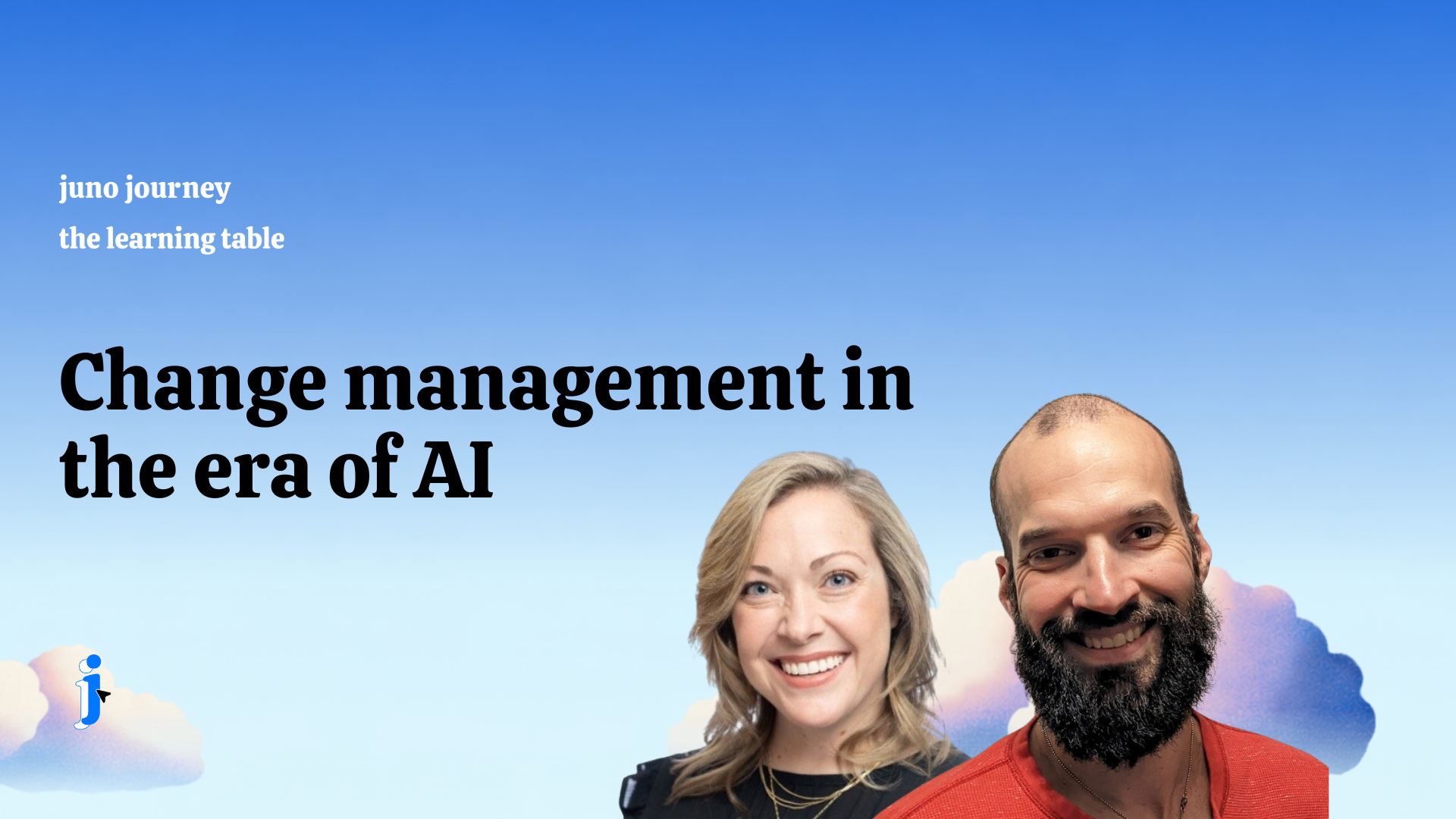
ICYMI: Change management in the era of AI
The playbook series
April 15th 2026 | Hosted by Klil Nevo: The Learning Table & Juno Journey
Experts Ashley Gutierrez, Andy Riel
ICYMI: Change Management in the AI Era – Why It Fails (and What Actually Works)
AI is already inside organizations. But execution still struggles.
Across industries, companies are experimenting with tools, running pilots, and investing in AI. And yet, adoption remains low, impact is unclear, and most initiatives stall before they create real change.
The challenge isn’t access to AI. It’s the gap between intention and execution.
In our latest session with Ashley Gutierrez and Andy Riel, we explored what’s really behind that gap—and what it actually takes to move from experimentation to real workforce readiness.
The Challenge
AI adoption fails before it even starts
Most organizations aren’t failing at implementation.
They’re failing at clarity.
Common blockers include:
- No clear outcomes or success metrics
- Lack of structured data or processes
- Too many tools, not enough direction
Without a clear “why” and “where to start,” AI becomes noise instead of leverage.
The real resistance is human, not technical
Low adoption is often framed as a skills or motivation issue.
In reality, it’s something deeper:
- Fear of the unknown
- Lack of time to learn
- Uncertainty about value
- “I’m not technical enough” mindset
What looks like resistance is often a natural human response to change and cognitive overload.
Organizations treat AI as a tool rollout, not a behavior shift
Many companies focus on:
- Training sessions
- Tool access
- Feature education
But skip the hardest part:
Changing how people actually work, daily.
Without that shift, AI stays in demos—not in workflows.
Juno’s Perspective: This Is a Workforce Readiness Problem
What we’re seeing aligns with a broader pattern:
AI adoption isn’t a tooling challenge.
It’s a capability and execution challenge.
Organizations don’t fail because they lack tools.
They fail because they lack a system that connects:
- Skills
- Workflows
- Behavior
- Business outcomes
This is exactly where Workforce Readiness becomes critical.
What Actually Works
Separate the problem: Human vs. Operational
One of the most powerful shifts from the session:
You can’t solve AI adoption as one problem.
You must separate:
- Human challenges → fear, habits, mindset, cognitive load
- Operational challenges → tools, processes, structure
Solving only one side leads to partial (and temporary) change.
Start with mindset, not tools
Before teaching people how to use AI, clarify:
- AI is not replacing you
- AI is a partner, not a decision-maker
- Human judgment is still the differentiator
This reframing reduces fear and creates psychological safety to experiment.
Give people a simple way to start (The “4Ds”)
One of the most practical frameworks shared:
Delegate → Describe → Discern → Diligence
- Delegate: Identify tasks that don’t require your unique value
- Describe: Give AI the right context and inputs
- Discern: Critically review the output
- Diligence: Ensure responsible and appropriate use
This turns AI from “overwhelming” into “actionable.”
Don’t start big. Start real.
The most successful use cases didn’t begin as transformations.
They started small:
- Improving internal communication
- Summarizing meetings into action items
- Automating repetitive workflows
Over time, these evolved into:
- Automated reporting systems
- AI-driven workflows
- Internal knowledge agents
Adoption grows through iteration, not perfection.
Build a system, not a one-time rollout
What actually drove adoption:
- Executive alignment and clear direction
- Safe spaces to experiment (workshops, open sessions)
- Internal champions driving use cases
- Clear guardrails (especially around security)
- Continuous feedback loops
AI adoption is not a project.
It’s an ongoing organizational capability.
The Outcome
Organizations that succeed don’t move faster because they have better tools.
They move faster because:
- They address the human side of change
- They embed AI into real workflows
- They build systems that scale behavior, not just knowledge
And most importantly:
They stop asking
“Did people learn AI?”
And start asking
“Can our people actually execute better with it?”
Final Thought
This is hard.
Not because AI is complex.
But because changing how people work always is.
The companies that win won’t be the ones with the most tools.
They’ll be the ones that build real readiness—where Human + AI actually work together, every day.