


























ICYMI: The HumAIn Panel | Berlin
Feb 19, 2026 · 7 min read · By Klil Nevo

Challenge accepted series
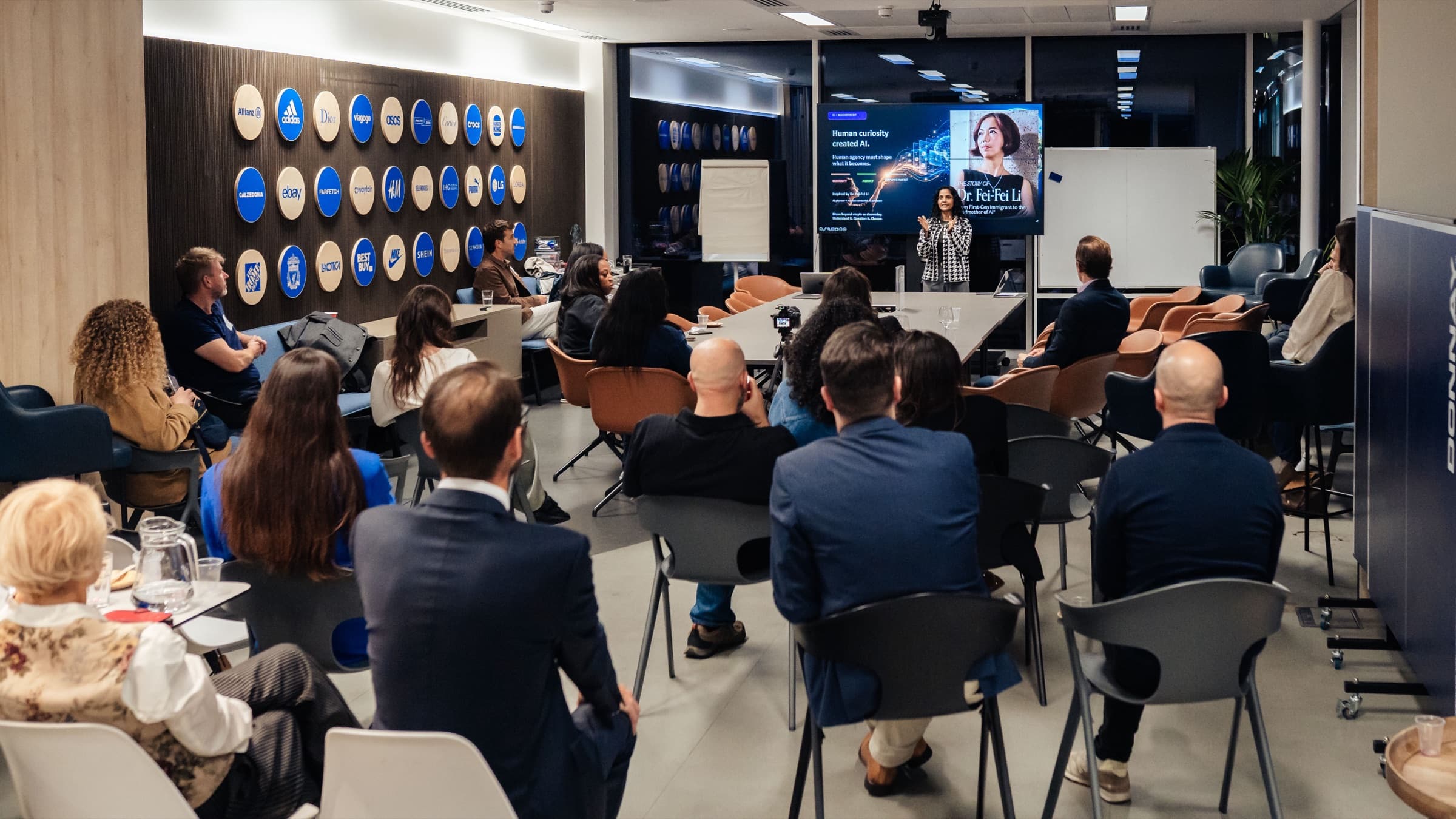
February 11th 2026 | Hosted by Juno Journey & PPlwise | Berlin
Moderator- Shlomit Gruman-Navot, Panelists- Sophie Wade, Angus Ridgway, and Manjuri Sinha
At the recent HumAIn dinner in Berlin, the conversation didn’t orbit around prompts, copilots, or the latest model release.
Instead, it tackled a much more uncomfortable question:
Why are companies pouring billions into AI — and still struggling to see real returns?
The panel, featuring senior leaders across legal, talent, strategy, and future-of-work domains, surfaced a critical insight for executives:
This is not a technology adoption moment.
It’s a work redesign reckoning.
And most organizations are still treating it like an IT upgrade.
1. The ROI Gap: Frenzy Is Not Strategy
One of the first themes raised was the growing gap between AI investment and measurable ROI.
Billions are being invested globally. Headlines celebrate valuations and “AI-first” declarations. Yet most organizations cannot clearly articulate:
- What problem AI is solving
- What workflows are being redesigned
- What measurable business outcomes are expected
Inside companies, AI adoption often looks like:
- A proliferation of bots
- Vendor-driven point solutions
- Efficiency gains are measured in minutes saved
- No meaningful shift in how work itself operates
The panel described it as a “Pac-Man frenzy” — companies chasing each other’s announcements rather than designing systemic change.
The result? Tool stacking without transformation.
2. The Real Issue: We Never Designed Knowledge Work Properly
One of the most important reframes of the evening:
Knowledge work was never properly designed in the first place. For decades, organizations digitized analog processes: email replaced memos, dashboards replaced binders, but they rarely rethought how work flows.
Digitalization is not a transformation.
Now, AI forces the question organizations avoided for 30 years:
- What exactly is the workflow?
- Where does judgment happen?
- What can be augmented?
- What should be automated?
- What must remain deeply human?
Without clarity on workflow architecture, AI cannot be integrated meaningfully.
This is why many AI transformations fail, not because the models aren’t capable, but because the work itself is undefined.
3. This Is a Work Redesign Moment, Not a Copilot Moment
A powerful example shared during the panel illustrated what real transformation looks like:
In one company, customer care was redesigned using agentic AI: systems in which AI agents communicate with each other, rather than humans interacting with a chatbot. Customer satisfaction rose above 95%.
But the bigger shift wasn’t in customer support.
It was in the product organization:
Product managers were no longer just product managers.
They became engineers, designers, go-to-market strategists — integrated roles operating across disciplines.
That is work redesign.
And it raises a deeper question:
If AI systems handle operational fragmentation, do human roles become more integrated, strategic, and cross-functional?
For HR, the implication is significant:
Will recruiters, business partners, and learning professionals remain separate — or will AI-enabled architectures collapse these boundaries?
Organizations that are redesigning work are documenting:
- Skills
- Capabilities
- Tasks
- What goes “below the line” (fully automated)
- What stays human
- What becomes augmented
Most companies are not doing this yet.
4. Brownfield vs. Greenfield: Why Transformation Feels So Painful
One panelist compared today’s AI moment to economic reforms in Eastern Europe in the 1990s.
There are two approaches:
- Brownfield transformation — retrofit legacy systems and people
- Greenfield transformation — start fresh
Greenfield is easier. Brownfield is reality.
The pain many leaders feel is not about AI. It’s about confronting:
- Legacy operating models
- Inconsistent human judgment
- Unclear values
- Undefined workflows
- Cultural resistance
AI exposes inconsistencies we previously ignored.
And that discomfort is being labeled as “hype fatigue” or “ROI gap”, when in reality it’s structural misalignment.
5. The Leadership Blind Spot: Why This Shouldn’t Sit Only with IT
Another critical insight: AI transformation is still largely landing with CIOs and CTOs. That’s a structural mistake.
Because this shift is fundamentally about:
- Work design
- Talent architecture
- Operating models
- Leadership capability
- Change management
In other words, it’s an organizational strategy.
The panel argued that:
- AI must sit at the intersection of technology and people strategy
- CHROs must co-own the transformation
- New hybrid roles will emerge (the discussion even hinted at something like a “Chief Work Architect”)
Companies like Moderna, Microsoft, Zapier, and others are beginning to treat AI as a coordinated transformation rather than an isolated implementation.
Most others are not there yet.
6. The Skills Shift: From Jobs to Skill Portfolios
Another profound shift discussed: The unit of work is moving from jobs to skills and projects.
Yet:
- Most employees don’t know their top 3–5 skills.
- Most organizations don’t have skill passports.
- Talent marketplaces are immature.
- L&D budgets are often being cut — even as AI transformation accelerates.
This creates a paradox:
Companies are hiring external “AI-fluent” profiles while underinvesting in reskilling their own workforce.
The long-term ROI will likely belong to those who:
- Redesign roles
- Invest in skill mapping
- Build internal capability, not just external talent acquisition
7. The Judgment Dilemma: What Happens When We Outsource Thinking?
Perhaps the most philosophical moment of the evening:
As AI becomes a co-creator — drafting, synthesizing, recommending — humans increasingly delegate judgment.
We’re already seeing:
- AI-generated documents that “look right” but lack substance
- Leaders using AI to pressure-test decisions
- Managers relying on models to synthesize performance
This raises two critical questions for senior leaders:
- How do we ensure human judgment doesn’t atrophy?
- How will leadership development evolve if experimentation and error increasingly happen in silico?
The panel highlighted emerging research showing that new AI-era tasks may actually require more human intensity, not less, especially in empathy, perspective, originality, and complex reasoning.
If routine tasks drop below the automation line, what remains is:
- Complex decision-making
- Trade-offs
- Ethics
- Systems thinking
- Human coordination
In other words, the human bar rises.
8. The Societal Question: Are We Weakening Our Cognitive Muscles?
The discussion began to move beyond the enterprise into society.
If AI handles:
- Recall
- Synthesis
- Drafting
- Analysis
What happens to our cognitive muscles?
Early research suggests measurable neurological differences in how people think with and without AI assistance. For senior leaders, this isn’t abstract.
It directly impacts:
- Workforce readiness
- Talent pipelines
- Education systems
- Leadership capacity
The question is not whether AI replaces intelligence.
It’s whether organizations intentionally design environments that strengthen — rather than erode — human capability.
Key Takeaways for Senior Leaders
If you are a C-level or senior HR/L&D executive, the HumAIn panel offered clear signals:
* AI ROI will not come from efficiency alone
Minutes saved are not a transformation.
* Work must be decomposed before it can be augmented
If you cannot articulate workflows, AI cannot meaningfully integrate.
* This is not an IT project
It’s an operating model redesign.
* Skills architecture is now a strategic infrastructure
Without skill visibility, mobility, and development, AI adoption stalls.
* Judgment becomes the new competitive edge
As automation increases, the human premium rises.
* Brownfield transformation requires courage
You are not just implementing tools; you are confronting legacy design.
The Underlying Tension
Perhaps the most honest insight of the evening was this:
AI is not just exposing technological gaps.
It is exposing organizational inconsistencies that we were able to live with before.
And that makes this moment uncomfortable.
But it also makes it historic.
For leaders willing to move beyond hype and beyond tool stacking, the opportunity is enormous:
Not just to implement AI.
But to redesign work, intentionally, systemically, and human-centrically, for the next decade.
And that is a far bigger conversation than any single model release.