


























ICYMI: What Practical AI Adoption Actually Looks Like in L&D
Feb 17, 2026 · 3 min read · By Klil Nevo
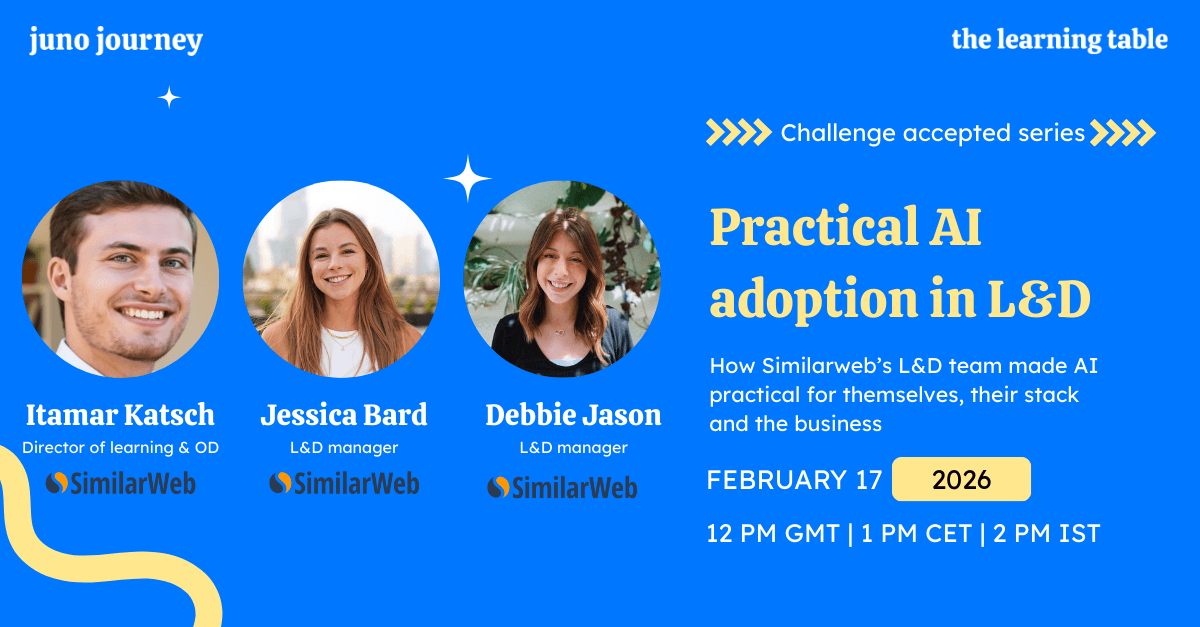
Lessons from Similarweb’s L&D Team
Challenge accepted series
February 17th 2026 | Hosted by The Learning Table & Juno Journey
Led by Itamar Katsch, Jessica Bard, and Debbie Jason
This webinar was different.
No theory. No “AI is the future.”
Just three L&D leaders from Similarweb sharing:
- What they actually implemented
- What didn’t work
- What they’d do differently
- And what’s already creating value
First — The Mindset Shift
Before tools, before workflows, before prompts…
The real shift was this:
AI adoption in L&D is not about replacing learning.
It’s about redesigning how value gets created.
The team didn’t ask:
“How can we use AI?”
They asked:
“Where are we wasting time? Where are we stuck? Where can AI unlock scale?”
That framing changes everything.
What They Actually Did (Across 3 Levels)
1️⃣ Individual Productivity
Using AI to:
- Speed up content creation
- Draft communications
- Improve learning materials
- Structure onboarding content faster
Not revolutionary.
But massively time-saving.
And here’s the important part:
They didn’t wait for perfection. They started small.
2️⃣ Team-Level Implementation
They moved from “everyone experimenting alone.”
to creating shared standards:
- Prompt libraries
- Best practices
- Internal sharing of wins and failures
- Open conversations about risks
AI became a team capability — not a private hack.
That’s when adoption accelerates.
3️⃣ Strategic Integration
The most interesting part?
They began asking:
- How does AI reshape onboarding?
- How do we personalize development paths?
- How do we move from static programs to adaptive learning?
This is where AI stops being a tool
and starts influencing L&D architecture.
The Mistakes They Shared (Which I Loved)
Because this is what makes it real.
They talked about:
- Overestimating how fast people would adopt AI
- Underestimating the need for clear guidelines
- Realizing that not everyone is equally comfortable experimenting
- Discovering that excitement ≠ structured implementation
AI adoption is emotional.
Not just technical.
That was one of the biggest takeaways for me.
The Underlying Theme: Psychological Safety
Adoption didn’t grow because of mandates.
It grew because:
- Leaders modeled experimentation
- Failure was normalized
- Sharing was encouraged
When people feel safe to try, they try.
And in L&D, we should know this better than anyone.
My Personal Reflection
What struck me most wasn’t the tools.
It was this: AI adoption in L&D becomes powerful when it moves from:
“Look what this tool can do" to “What capability gap are we solving?”
That’s the difference between experimentation
and workforce readiness.
And Similarweb’s team is clearly thinking beyond productivity hacks — they’re thinking systemically.
That’s where the real impact lives.
🔎 The Short, To-The-Point Takeaways
- AI adoption must start with business pain, not tool excitement
- Small experiments beat big declarations
- Shared learning > isolated experimentation
- Psychological safety drives adoption
- Governance and clarity matter early
- Productivity wins create credibility
- Strategic integration takes time
- AI literacy is uneven — support accordingly
- Leaders must model usage
- Adoption is cultural before it is technical