




















ICYMI: Fishbowl Role play
Jan 22, 2026 · 8 min read · By Klil Nevo
The playbook series #1
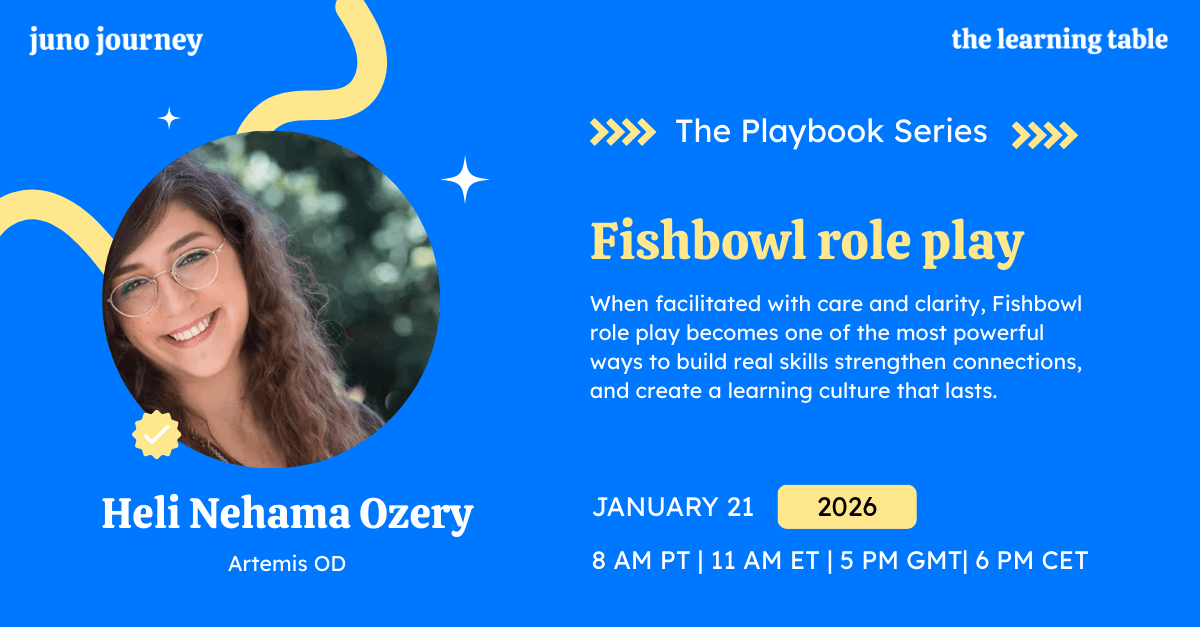
January 21, 2026 | Hosted by The Learning Table & Juno Journey
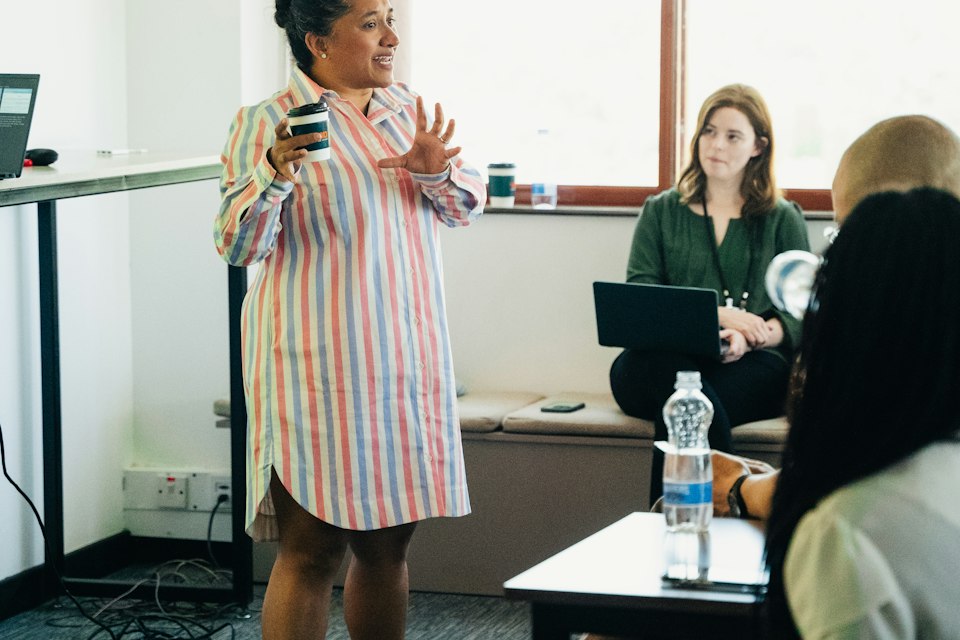
In this Learning Table community session, Heli Nehama Ozery (Founder & CEO of Artemis OD) walked us through her Fishbowl Role-Play approach, not as “put someone on the spot and hope it goes well,” but as a structured, safe, group-learning engine.
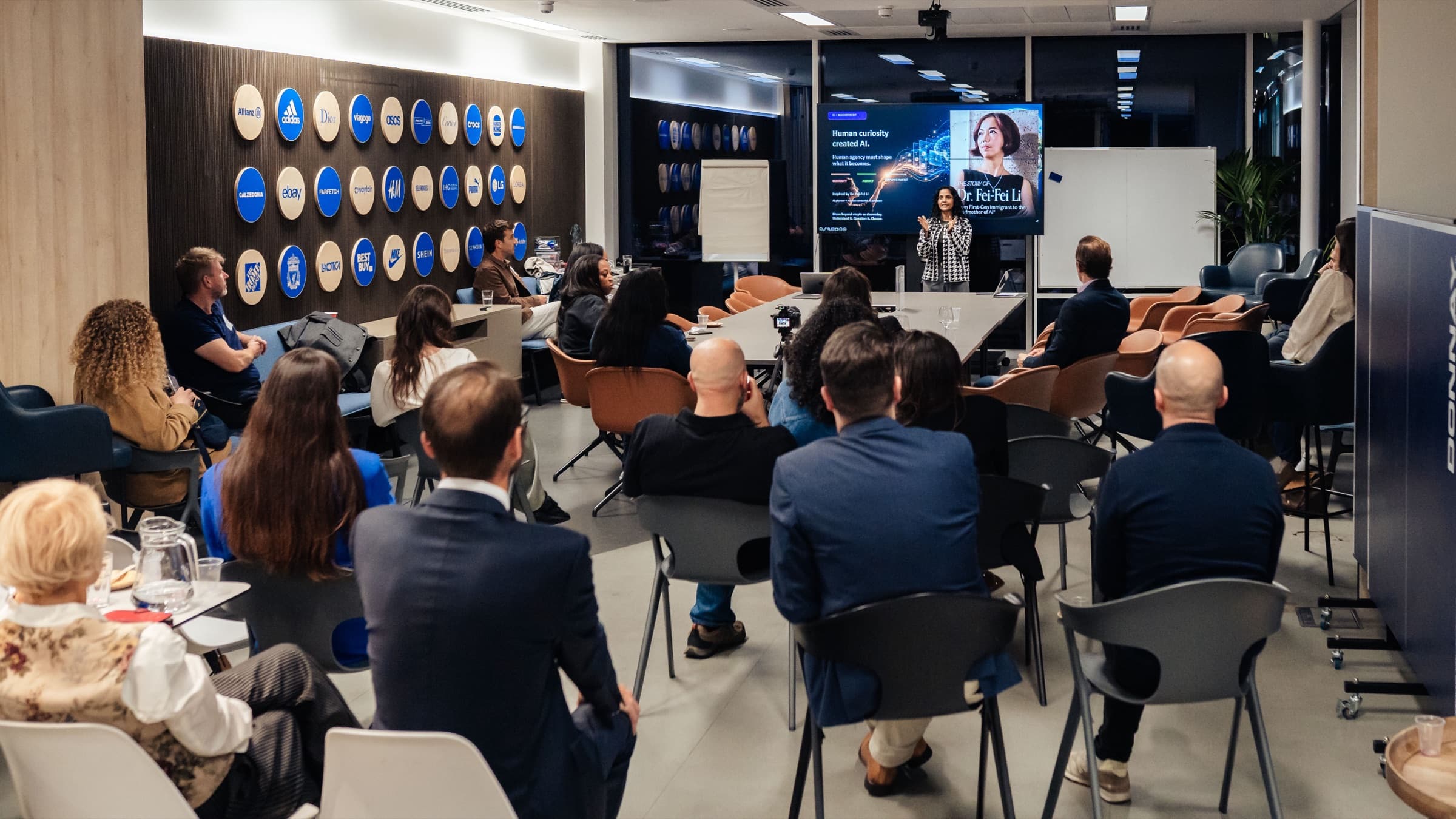
Hosted by Klil Nevo, Head of Community at The Learning Table (powered by Juno Journey), this was one of our first sessions designed for open participation, cameras on, mics open, real examples from the room.
Below is a recap you can share as a post-webinar article (plus a few frameworks you can copy/paste into your next workshop).
What this session was really about
Fishbowl role-play has a reputation.
People hear “role-play in front of the group” and immediately think: awkward, unsafe, only the bravest person learns, everyone else checks out...
Heli’s argument was the opposite:
Fishbowl role-play can be one of the fastest ways to build capability — if you stop treating it like a performance and start treating it like a group learning practice.
That shift changes everything.
A quick moment of context: why Heli teaches this
Heli shared that her relationship with experiential learning started early.
At 18, during her military service as a basic training commander, she discovered something she hadn’t experienced in school: learning through practice, observation, and feedback — repeatedly.
For months, the model was simple:
- Someone leads
- Everyone observes
- Everyone gives feedback
- Everyone gets better
In her words, it was essentially “three months of fishbowl role-playing.”
Later, when she started facilitating in corporate settings, she hit the hard truth:
Fishbowl role-play is effective… and it can also go badly.
Too long. Too painful. Group disengages. The person in the hot seat feels judged.
So she started experimenting — and landed on what became her core principle:
When role-play becomes a group activity, the dynamic changes.
The opening question: what can learning not happen without?
Heli kicked off with a quick Slido prompt:
“What is the one thing learning cannot happen without?”
The dominant answer: motivation to learn.
She agreed — and used it to set up the rest of the session:
We can learn even without a perfect structure. We can learn even without full psychological safety.
But without wanting to learn, nothing sticks.
And here’s the key tie-in:
Fishbowl done well increases motivation because people don’t just hear the tool — they witness it, feel the energy shift, and leave wanting to try it.
What “fishbowl role-play” means (in this session)
Heli grounded the definition:
- Two people role-play a scenario (sometimes one person, depending on the context)
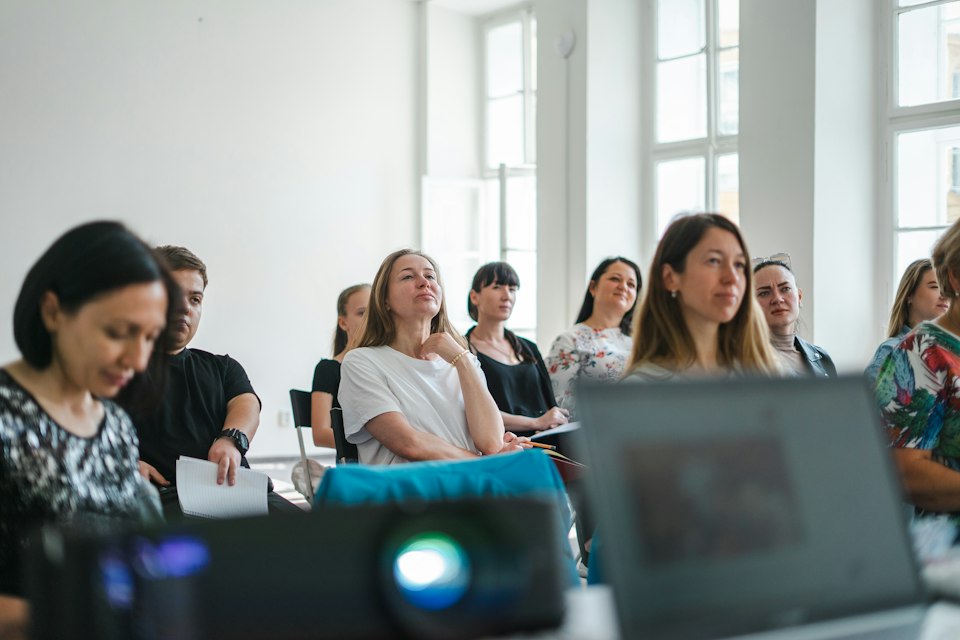
- The entire group observes
- The group is actively engaged: notes, reflection, feedback
- Everyone learns together
This is not pairs. This is not breakouts.
This is: the group is the learning unit.
Why most facilitators avoid the fishbowl
Heli asked the room what holds facilitators back.
The answers came fast:
- unpredictability
- shy groups
- fear people won’t participate
- inappropriate peer feedback
- culture differences
- discomfort/fear of judgment
- “hot seat” anxiety
- Loss of control
- Concern that the group will disengage because only two people are practicing
Heli summarized it in one line:
It feels too risky — for participants and for facilitators.
And she validated that. Those fears are legit. It does happen.
Which is why the solution isn’t “just be brave.”
The solution is a different mindset + a facilitation framework.
The mindset shift that makes fishbowl work
Heli named two mindsets.
Old mindset: performance
Focus is on the person in the hot seat.
- Did they do it “right”?
- Did they follow the steps?
- Did they perform the model?
But the odds are against them. They just learned something new. It’s stressful.
As Heli put it (via her teenager):
“My brain is not braining.”
So, expecting performance is unrealistic — and it increases fear.
New mindset: group learning
The focus becomes:
- What did the group learn from the interaction?
- Where did the energy shift?
- What changed when the tool was used vs. not used?
- What escalated things?
- What de-escalated things?
And — crucially — expectations are reset:
The person in the hot seat is going to make mistakes. It’s not an if. It’s a given.
Mistakes aren’t a problem. They’re the raw material for learning.
The live demo: “Agree + Answer” in a real conflict
To demonstrate the fishbowl, Heli taught a simple conflict tool first:
The “Agree + Answer” framework
Before you respond to a conflict:
-
Agree on something (even 10%) — or reflect on what you understand
-
Then share your perspective/answer
She had participants bring real work conflicts and write one line that the other person said (a quote). Then everyone drafted a response using the framework.
And then came the fishbowl.
The role-play scenario
Resa Jerome volunteered (brave human alert), using a real CX training mandate:
- global initiative
- US SVP pushing back hard
- timing right before Thanksgiving
- pressure, dismissal, short fuse
Heli played the SVP — intentionally dismissive to mirror reality — and Resa practiced “Agree + Answer” live.
The role-play wasn’t about “nailing it.” It was about watching the interaction.
The feedback that made the learning land
After the role-play, the group reflected.
One of the most useful moments came from Jason Aydelott, who called out a nuance that many facilitators miss:
Don’t over-agree
Saying “I totally agree with you” can backfire. Because it communicates: you are 100% right.
Then any pushback sounds passive-aggressive.
Instead:
- agree to a specific point
- name the reality
- Then connect the answer to business outcomes
Jason also added something that hit:
Don’t give away your power
When you say, “This isn’t me, it’s global,” you can unintentionally reduce your influence.
A more powerful stance is partnership:
- Acknowledge where the ask is coming from
- Stay grounded in your role
- Invite the other leader to co-escalate as two voices aligned
Melinda Stallings built on it with a practical lens:
In many organizations, “global says do it” is real — and the move is how you hold your authority and tone inside that reality.
Heli summarized the point beautifully:
It’s not only what you say — it’s how you say it.
Tone is strategy.
The Fishbowl Facilitation Framework: SFS
Then Heli revealed her facilitation structure for running a fishbowl well:
SFS: Set the Stage → Facilitate the Role-Play → Steer the Feedback
1) Set the Stage
This is everything that makes the room safe enough to try:
- Say explicitly: it will be awkward
- set expectations: we’re not looking for excellent performance
- tell the group what to watch for (interaction, energy, escalation/de-escalation)
Heli noted that with a new group, you also need ground rules, such as:
- no side conversations/laughter (in-person)
- no unsolicited suggestions from the audience (only facilitator)
- Feedback norms that protect psychological safety
2) Facilitate the Role-Play
Key moves:
- keep it short (ideally under 5 minutes)
- set your intention: hold the space without judgment
- It’s okay for the facilitator to play the other role early on (to model contrast)
if needed, gently redirect in real time (e.g., “remember: agree first”)
Most important:
Protect the person in the hot seat.
The exercise only works when the volunteer feels safe.
3) Steer the Feedback
Heli’s sequence:
-
pause → let everyone reflect (avoid anchoring bias)
-
The person in the hot seat shares first
-
group shares
-
facilitator calls out key moments
-
Focus on what we want to see next time
And she added a powerful layer:
Fishbowl is group learning not only because the group watches, but because the group learns how to give feedback.
Early feedback-givers also get coached. So everyone is practicing. Everyone is accountable. Everyone is “in the hot seat,” not just the volunteer.
“Did you ever have a group where it went wrong?”
Klil asked the question everyone is thinking.
Heli’s answer was honest:
Early in her career, yes — when she didn’t understand psychological safety.
Now, when something starts to go off:
- She names it
- owns it
- takes a step back with the group
Because vulnerability is part of the method.
“I make mistakes as well… this is what it looks like when we make mistakes.”
The real payoff: motivation
Heli returned to the opening theme: motivation.
When people witness a role-play and feel the shift, they become more motivated to try the tool themselves.
They don’t just understand it cognitively. They experience it.
And that matters, because in the real world:
- attention is limited
- mental space is limited
- Practice doesn’t happen unless motivation is high
Fishbowl done well creates that motivation.
The closing line
Heli closed with a quote that basically summarizes the whole session:
“You can choose courage, or you can choose comfort. You cannot have both.”
And then a practical gift: a job aid participants can reuse.
(It’s a job aid, not a prison. 🙂)
The takeaway for facilitators
If you’re building soft skills, leadership capability, feedback culture, or conflict competence, fishbowl is one of the most effective tools available.
But only if you stop running it like a performance.
Run it like a group learning system:
- set the stage
- keep the pace
- steer feedback toward growth
- protect the volunteer
- coach the feedback-givers
And you’ll see what Heli described:
Shared vulnerability → shared language → trust → stronger workplace connections → faster skill-building.
If you want the job aid or have questions about applying SFS in your next workshop, reach out to Heli Nehama Ozery — or to Klil via The Learning Table community.