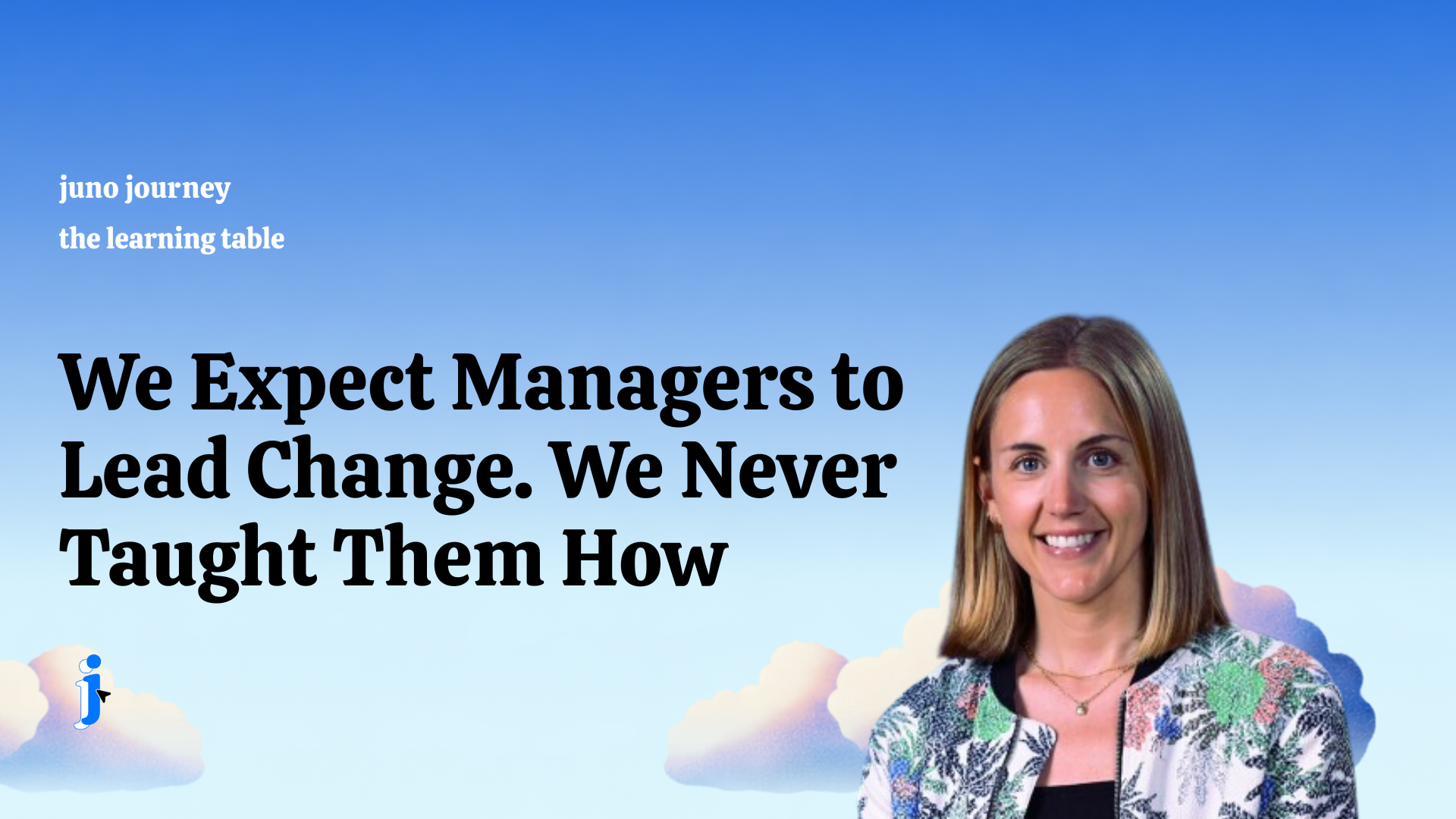
ICYMI: We Expect Managers to Lead Change. We Never Taught Them How
Challenge Accepted series
June 10th, 2026 | Hosted by Klil Nevo: The Learning Table & Juno Journey
Expert: Hilary Folkes
ICYMI: We Expect Managers to Lead Change. We Never Taught Them How
Organizations today are navigating constant disruption.
AI transformation. New systems. Restructures. Shifting priorities. Economic pressure. Endless communication.
And while executives design the strategy, one group is ultimately responsible for making change real:
Managers.
In our latest Learning Table session, we were joined by Hilary Folkes, Director of Talent Enablement & Inclusion at Varicent, for an honest and practical conversation about one of the biggest challenges organizations face today:
Managers are expected to lead change, but very few have ever been taught how.
Drawing from her experience building a company-wide change leadership capability, Hilary shared how her team moved from assuming managers would figure it out on their own to intentionally equipping them with the skills, tools, and support needed to navigate uncertainty.
Every Transformation Eventually Lands on a Manager
Hilary opened with a familiar scenario.
A company-wide change announcement lands in a manager's inbox late in the day.
By the next morning, their team is looking to them for answers.
What does this mean for us?
How will this impact my role?
What should we do next?
The challenge is that most managers receive these questions before they have fully processed the change themselves.
Yet they are still expected to communicate clearly, reduce uncertainty, answer difficult questions, and keep work moving forward.
As Hilary put it, managers become the bridge between strategy and employee experience.
Organizations create the strategy.
Employees experience the change.
Managers sit in the middle translating one into the other.
The "Manager Squeeze" Is Real
One of the most powerful concepts discussed during the session was what Hilary calls the manager squeeze.
Managers are caught between competing pressures:
From above:
- Constant organizational change
- New priorities and initiatives
- Pressure for faster execution
- Continuous communication
From below:
- Employee concerns and questions
- Burnout and uncertainty
- Requests for clarity and reassurance
- Resistance to change
Managers are expected to absorb all of this complexity and turn it into something meaningful for their teams.
The problem isn't usually resistance.
It's overload.
And when managers become overwhelmed, the employee experience suffers.
The Hidden Cost of Poor Change Enablement
At Varicent, Hilary's team began noticing warning signs.
Communication scores were declining.
Employees were becoming less clear on company direction.
Individual contributors had significantly less confidence in organizational priorities than leaders did.
Interestingly, employees still reported receiving information from their managers.
The issue wasn't communication frequency.
The issue was translation.
Messages were being created at the top of the organization but were losing clarity before reaching teams.
Hilary described it as a giant game of "broken telephone."
That realization led to an important conclusion:
The organization didn't have a communication problem.
It had a change leadership problem.
Stop Expecting. Start Equipping.
One of the most important mindset shifts from the session was moving from:
"Why aren't managers doing this better?"
to
"How can we help managers get better at this?"
Most managers genuinely want to lead well.
But very few have ever been formally taught how to:
- Communicate change effectively
- Navigate resistance
- Manage stakeholder concerns
- Lead through ambiguity
- Support employees emotionally during uncertainty
Change leadership isn't an instinct.
It's a skill.
And like any skill, it can be developed.
Building Change Leadership as a Capability
Recognizing this gap, Hilary's team created a structured change leadership curriculum.
The goal wasn't simply to train managers.
It was to create a common organizational language around change.
The program started with foundational learning focused on:
- Personal resilience
- Mindset
- Navigating change individually
From there, managers learned practical skills for:
- Communicating change
- Managing resistance
- Supporting employees through uncertainty
- Leading change conversations
The result wasn't just better understanding.
Managers reported being able to apply what they learned immediately in real workplace situations.
And that practical relevance proved critical for adoption.
A Simple Framework Any Manager Can Use
Hilary shared a condensed version of the framework they teach managers.
1. Understand the Change Yourself
Before leading others, managers need answers.
What is changing?
Why is it changing?
How will it affect the team?
What questions are likely to come up?
2. Lead Yourself Through the Change
Managers are people too.
They experience uncertainty, concern, and resistance just like everyone else.
Before they can support others, they need to process their own reactions and focus on the outcomes they need to lead toward.
3. Lead Others Through the Change
Managers become translators.
Their role is to:
- Communicate early and often
- Create safe space for discussion
- Reinforce key messages
- Meet employees where they are
- Recognize that everyone adopts change differently
The objective is not simply sharing information.
It's helping people move through uncertainty.
The Power of Better Conversations
One of the most practical sections of the webinar focused on manager conversations.
Because the question managers repeatedly asked was:
"What do I actually say?"
Hilary's guidance was simple.
Before change:
- Create awareness
- Explain why it matters
- Connect it to employees personally
During change:
- Check in frequently
- Offer support
- Clarify confusion
- Recognize progress
After change:
- Reinforce new behaviors
- Celebrate wins
- Continue coaching
- Address lingering resistance
And throughout the process:
Lead with empathy.
Communicate more often than feels necessary.
Be honest about what you know and what you don't know.
Because change leadership isn't about delivering one perfect message.
It's about helping people navigate uncertainty through ongoing conversations.
The Next Frontier: AI-Powered Manager Enablement
After seeing positive results from training, Hilary's team identified a new challenge.
Managers understood the concepts.
They just didn't always have time to apply them.
That's where AI enters the picture.
Rather than replacing managers, Varicent is exploring AI as a change leadership co-pilot.
Imagine receiving a major organizational announcement at 4 PM.
Instead of spending hours interpreting it, a manager could upload the communication into an AI tool and immediately receive:
- Key messages to reinforce
- Likely employee questions
- Suggested talking points
- Team-specific implications
- Conversation preparation guidance
The goal isn't automation.
It's reducing cognitive load.
Managers still provide the judgment, context, relationships, and trust.
Technology simply helps them spend less time decoding change and more time leading people.
Final Thoughts
Hilary closed the session with a powerful reminder:
Change succeeds locally before it succeeds organizationally.
No employee experiences change through a strategy document.
They experience it through their manager.
That means organizations cannot afford to treat manager readiness as optional.
The companies that invest in equipping and enabling managers today will be far better positioned for every transformation that follows.
Because every transformation eventually lands on a manager.
And managers need support too.