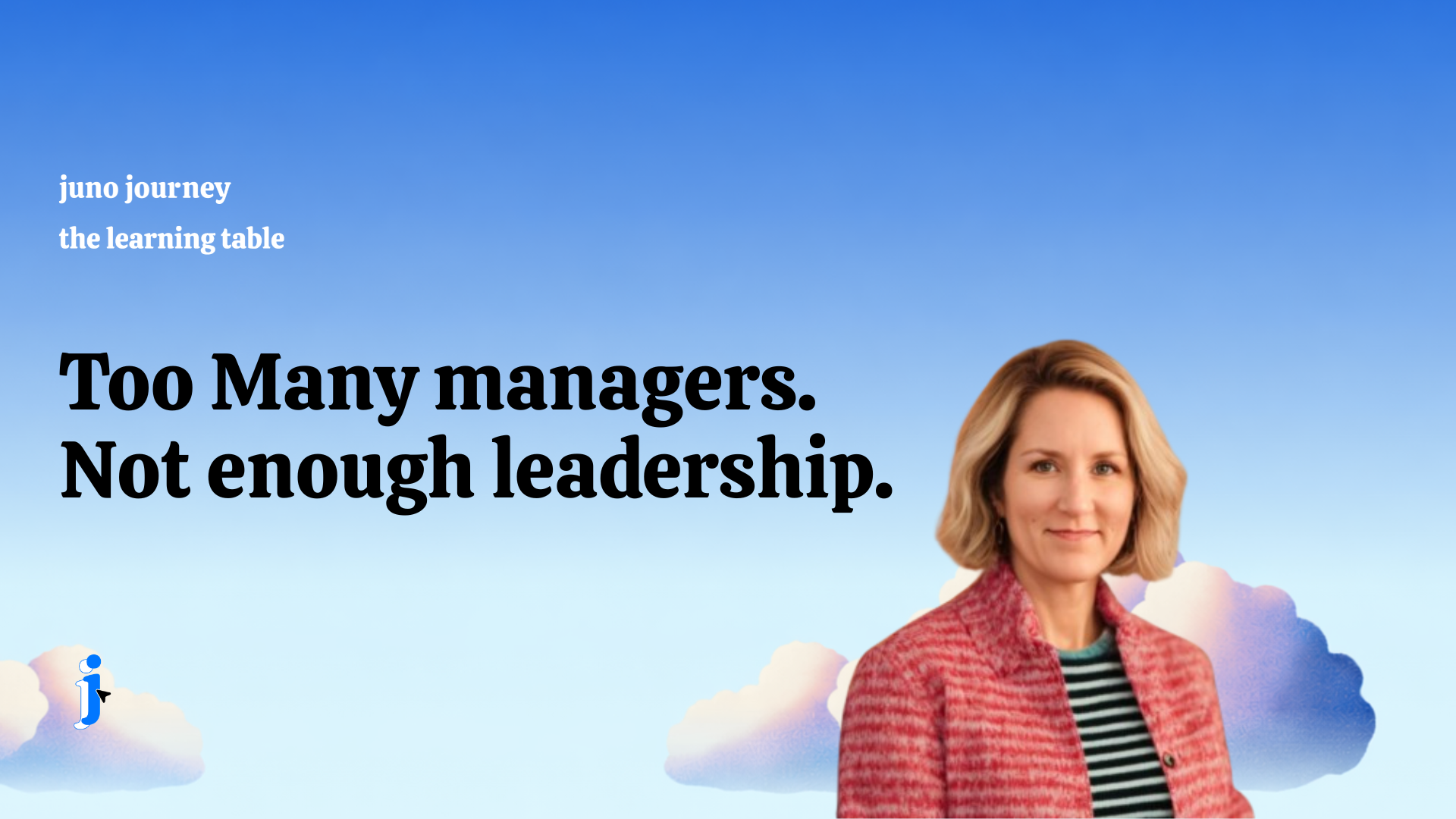
ICYMI: Too Many managers. Not enough leadership.
Challenge Accepted series
June 23rd, 2026 | Hosted by Klil Nevo: The Learning Table & Juno Journey
Expert: Ann Watson
ICYMI: Too Many Managers. Not Enough Leadership.
As organizations scale, leadership structures often evolve without anyone intentionally designing them.
A manager gets promoted because they're a top performer. A team splits. Another layer is added. Someone needs career growth, so management becomes the default next step.
Over time, organizations wake up to an uncomfortable reality:
They have plenty of managers, but not necessarily enough leadership.
In our latest Learning Table webinar, Ann Watson, Chief People Officer at Cover Genius, shared how her team uncovered this challenge, the surprising data behind it, and the practical steps they're taking to rethink management, career growth, and leadership development.
Rather than offering a simple solution, Ann offered a refreshingly honest look at a challenge many growing organizations face today.
The Problem Wasn't What They Expected
The conversation started with a surprising discovery.
At Cover Genius, manager scores in employee engagement surveys were consistently among the highest in the company. Employees reported positive relationships with their managers and felt supported by them.
At the same time, the organization was struggling with manager-driven processes such as onboarding, performance management, probation reviews, development conversations, and feedback cycles.
The contradiction was hard to ignore.
Employees liked their managers, yet many of the critical moments that shape the employee experience weren't happening consistently or effectively.
This raised a deeper question:
Do we have a management structure that is truly enabling leadership and employee growth?
When Management Becomes the Default Career Path
One of the biggest insights from the session was how easily organizations can drift into creating more managers than they actually need.
Promotions are often the most visible form of recognition. As a result, becoming a manager becomes synonymous with career progression.
The challenge is that not everyone who deserves growth should necessarily move into people management.
And when management becomes the primary way to recognize performance, organizations can unintentionally create layers of managers without creating stronger leadership capability.
Ann shared that when her team analyzed their management structure, they discovered an unusually high number of managers leading only one, two, or three people, while other managers were responsible for much larger teams.
The issue wasn't simply the number of managers. It was the overall design of leadership across the organization.
Leadership Requires More Than a Promotion
One of the strongest messages from the discussion was that leadership is not something people automatically learn once they receive a title.
Many managers are expected to handle hiring, onboarding, feedback conversations, career development discussions, performance challenges, and even exits with very little practical preparation.
Organizations often deliver manager training as a one-time program and hope people remember what they learned when the moment arrives.
But leadership doesn't work that way.
The most effective support happens when managers receive guidance at the exact moment they need it.
When they need to hire.
When they need to onboard.
When they need to deliver difficult feedback.
When they need to support career growth.
Leadership capability grows through practice, support, and real-world application—not through a certificate earned months earlier.
Creating More Ways to Recognize Growth
A major theme throughout the session was the need to separate career development from management promotions.
If promotion is the only visible sign of growth, employees will naturally pursue it.
Instead, organizations should create multiple ways for people to experience progression, recognition, and development.
This includes:
- Clear learning pathways
- Skills-based growth opportunities
- Recognition programs
- Career development frameworks
- Expanded opportunities to build influence and expertise without managing people
When employees can see multiple paths forward, management becomes a choice rather than the only option.
How AI Can Support Better Managers
The conversation also explored the role of AI in leadership development.
Interestingly, Ann noted that the most valuable uses of AI today aren't necessarily teaching managers how to lead.
Instead, AI is helping managers become more present and effective in their day-to-day interactions.
Examples included:
- Reducing recency bias during performance reviews
- Helping managers recall important context from previous conversations
- Tracking commitments and follow-ups
- Surfacing information that strengthens coaching conversations
- Supporting managers who are balancing increasingly large workloads
Rather than replacing the human side of management, AI is helping managers create more meaningful human interactions.
And that may be one of its most valuable contributions.
Final Thoughts
Perhaps the most important takeaway from the session was this:
The goal isn't to have fewer managers. The goal is to create better leadership.
That requires organizations to rethink how they define success, recognize growth, and prepare people for leadership responsibilities.
As businesses continue to evolve, the organizations that thrive won't be the ones with the most managers.
They'll be the ones who intentionally build leadership capability at every level.