ICYMI: Communication as connection
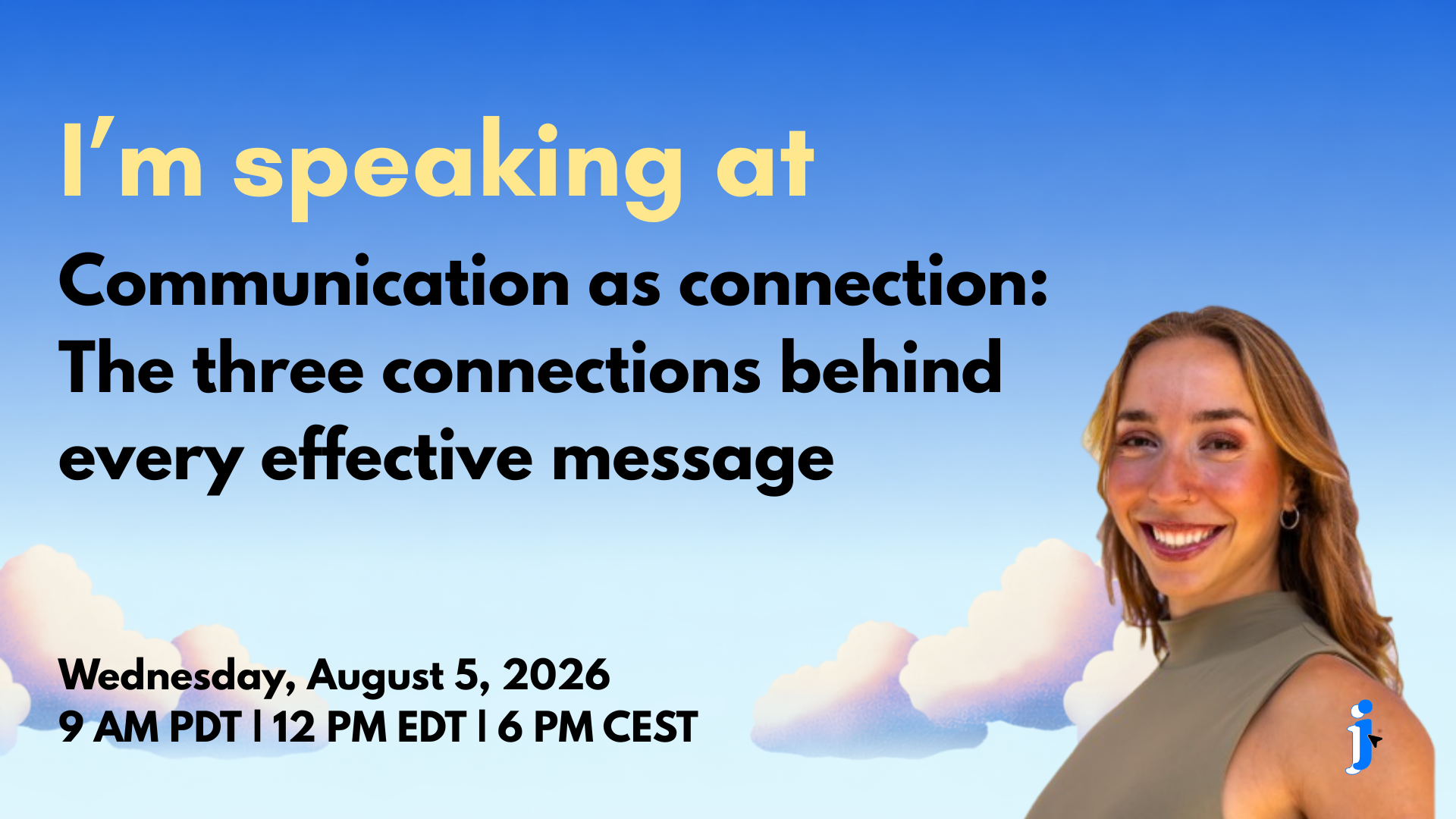
Challenge Accepted series
August 5th, 2026 | Hosted by Klil Nevo Juno Journey
Expert: Katya Davydova
ICYMI: Great Communication Isn't About Better Words. It's About Better Connection.
"Communicate better."
It's probably one of the most common pieces of advice we hear at work.
And also one of the least helpful.
What does "better" actually mean? Better slides? Better storytelling? Better public speaking?
In our latest Learning Table session, communication coach and executive facilitator Katya Davydova challenged that assumption entirely.
Her message was simple but powerful: communication rarely breaks down because we don't know enough words. It breaks down because we've lost connection.
The session introduced a framework built around three essential connections that sit behind every message that truly lands:
- Connection to your audience – understanding what they need, care about, and are ready to hear.
- Connection to your message – distilling complex ideas into something clear, memorable, and actionable.
- Connection to yourself – showing up with presence instead of getting trapped in self-consciousness.
One of the strongest moments came when Katya asked participants to simplify an upcoming conversation into a single sentence.
Not because complex ideas should become simplistic, but because clarity is earned through focus.
If you can't explain your message in one sentence, there's a good chance your audience won't know what they're supposed to take away from it either.
Another powerful shift was moving from performance mode to service mode.
Many of us enter important conversations asking ourselves:
"Am I saying this right?"
"Do I sound confident?"
"Will they like me?"
Katya encouraged us to replace those questions with a different one:
"How can I best serve the people in front of me?"
It's a small shift in mindset that changes everything. The spotlight moves away from ourselves and onto creating understanding for others. Ironically, that's often when confidence and authenticity show up naturally.
Perhaps the biggest reminder from the session was that communication isn't about transmitting information.
It's about helping another human being understand, connect, and act.
In a workplace filled with constant change, AI, hybrid teams, and endless meetings, that ability may be one of the most valuable leadership skills we can develop.
Because the conversations that change organizations rarely begin with perfect words.
They begin with genuine connection.
5 Key Takeaways
- Start with your audience, not your agenda. Before preparing any important communication, ask yourself: What does my audience need from this conversation? The more relevant your message is to them, the more likely it is to create action.
- If people leave with different interpretations, your message isn't clear enough. Distill every communication down to one core idea. Use the One-Sentence Test: After this conversation, I want my audience to understand ___ and/or do ___.
- Move from performance mode to service mode. Stop worrying about how you come across and focus on how you can help your audience. Presence grows when attention shifts away from yourself and toward serving the conversation.
- Presence comes before confidence, not the other way around. You don't need to eliminate nerves to communicate effectively. Choose intentionally how you want to show up—curious, calm, compassionate, direct—and let that guide your communication.
- Communication isn't about transmitting information; it's about creating understanding. Strong organizations aren't built by sending more messages. They're built by creating shared understanding through meaningful connection with your audience, your message, and yourself.