ICYMI: The Leadership Table: Are We Asking the Wrong Questions About AI?
The Leadership Table series
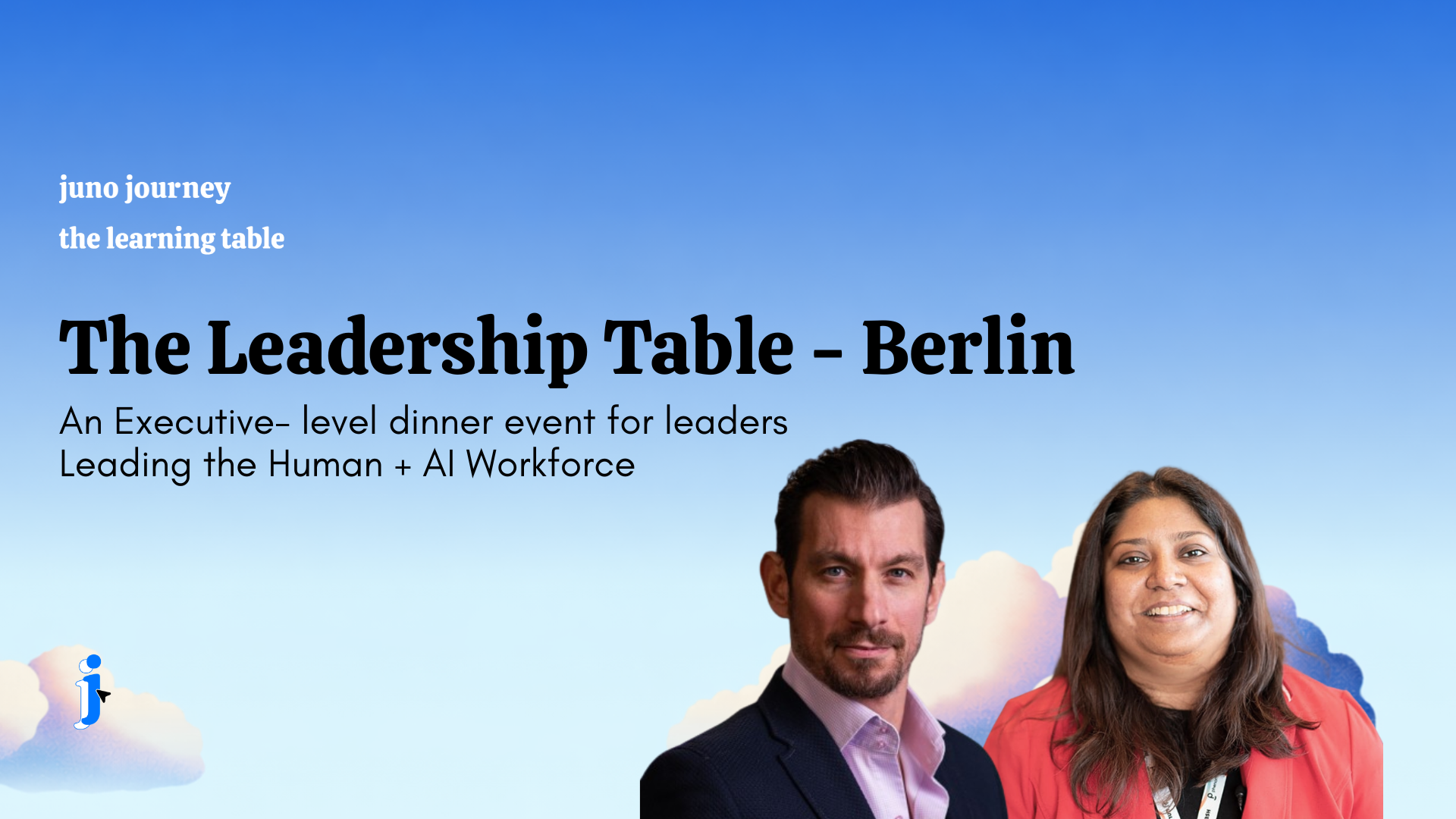
September 15th, 2026 | Hosted by Juno Journey, Berlin
Experts: Blake Wittman and Manjuri Sinha
ICYMI: Are We Asking the Wrong Questions About AI?
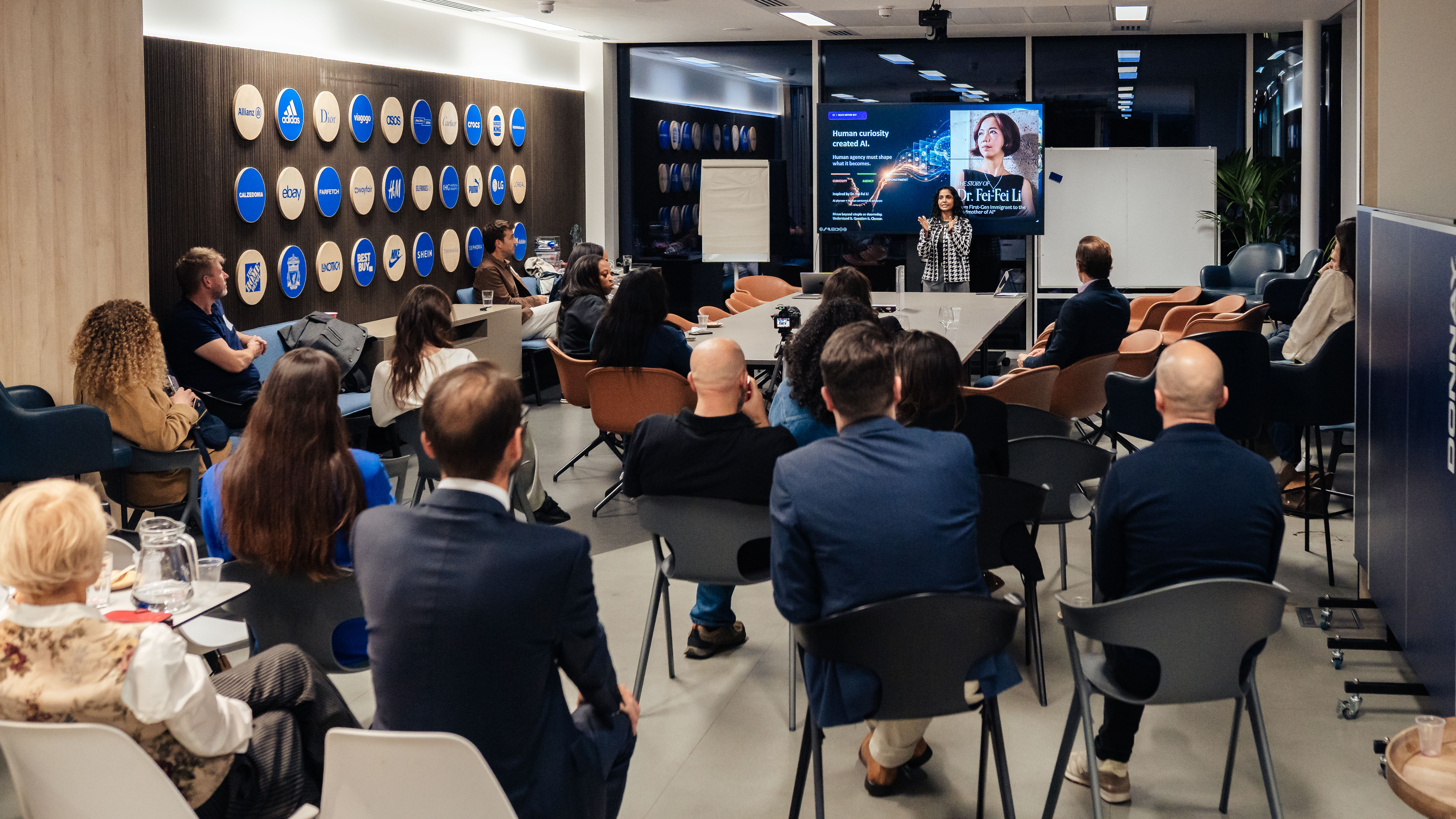
On September 15, The Leadership Table brought together some of Berlin’s most inspiring and thought-provoking People, HR, L&D, Talent, and business leaders for an evening built around a simple idea:
Let's not pretend we have all the answers. Let's just the conversations senior leaders actually need to be having.
And there was plenty to talk about.
The evening’s panel brought together Manjuri Sinha, VP HR at Miro, and Blake Wittman of GoodCall for a conversation about AI, leadership, productivity, human judgment, and the role HR should, and shouldn’t, play in what happens next.
What made the discussion interesting wasn’t another debate about whether AI will replace jobs.
In fact, Manjuri made it pretty clear that she thinks we should move past that question.
The much more interesting questions are:
What are we actually trying to achieve with AI?
What happens to the time it gives us back?
Where should humans deliberately stay in the loop?
And who inside an organization should be making those decisions?
Here are some of the ideas that stayed with us.
1. Stop asking whether AI should move faster or slower
The conversation started with a timely question.
After years of being told to move faster, experiment more and avoid being left behind, some of the people building the world’s most advanced AI systems have started publicly talking about slowing things down.
But Manjuri challenged the premise of the question itself.
For organizations, “faster or slower?” may be the wrong question.
She pointed to an example of recruiting and Talent Acquisition teams reportedly getting significant amounts of time back through AI. But saving time is only the beginning of the conversation.
If AI gives someone 20% of their week back, what happens to that 20%?
Do they simply process more candidates?
Attend more meetings?
Produce more output?
Does the company reduce headcount?
Or does that time create something genuinely more valuable?
As Manjuri put it during the discussion:
“Great, that’s productivity. Where’s the value?”
That distinction matters.
We’ve become very good at talking about efficiency. Less good at defining what we actually want to do with it.
And perhaps that needs to happen before we deploy the technology, not after.
2. Saving 20% of someone's time does not equal needing 20% fewer people
This became one of the most practical parts of the discussion.
There’s an appealing simplicity to the equation:
AI saves 20% of a team’s time → therefore the organization needs 20% fewer people.
Except work doesn’t operate that neatly.
If five people each save 20% of their time, that doesn't automatically mean one person's entire job has disappeared. People perform different activities, hold different context and judgment, and use that recovered capacity in different ways.
The more useful question becomes:
What can this team now accomplish that it couldn't accomplish before?
That changes the conversation from cost reduction to capacity creation.
And it forces leadership to define what productivity actually means — and how they intend to measure the impact AI is creating.
3. We may be automating exactly the wrong things
One of the strongest ideas of the evening was what Manjuri called:
“Leadership abdication.”
Her argument was simple.
Look at some of the tasks organizations are most eager to hand to AI:
Writing performance feedback.
Making parts of hiring decisions.
Communicating with candidates.
Handling difficult customer conversations.
But why these tasks?
Sometimes, it may not be because AI is uniquely suited to them.
It may be because humans don't particularly like doing them.
Managers don't always enjoy writing difficult feedback. Hiring managers don't always enjoy documenting decisions. Leaders don't always enjoy uncomfortable conversations.
So technology becomes an opportunity to remove the discomfort.
But discomfort and lack of value are not the same thing.
Some of the moments we most want to automate are also the moments where empathy, accountability, context and judgment matter most.
That gives leaders a very different question to ask before automating a process:
Are we removing low-value work — or simply work humans would rather avoid?
4. “Human in the loop” only works if the human actually adds something
The discussion then moved into human oversight.
We talk constantly about keeping a “human in the loop” when AI makes consequential decisions.
But Blake shared something he'd recently heard in a technology discussion: the checkpoint in the loop doesn't necessarily have to be human. It could potentially be another AI system.
Which raises an uncomfortable question:
What exactly is the human there for?
The answer that emerged from the conversation wasn't simply “because humans are better.”
It was context.
Judgment.
Experience.
Knowing why the number in the HR system doesn't look right.
Knowing that inactive employees are still being counted.
Knowing that a certain group consists of fixed-term contractors even when the dataset doesn't make that obvious.
AI can reason over the information available to it.
But organizations contain enormous amounts of context that never made it into the system in the first place.
And that leads directly to another problem.
5. Your AI strategy may actually be a data strategy
We spend a lot of time discussing models, agents, prompts and tools.
But Manjuri pointed to something considerably less glamorous:
data discipline.
Ask your HR system for company headcount.
Then ask Finance.
How confident are you that you'll get exactly the same number?
For many organizations, you won't.
And if the underlying systems contain inconsistent, incomplete or poorly structured information, adding increasingly sophisticated AI on top doesn't magically fix the foundation.
It can simply produce answers faster.
As the discussion highlighted, the need for human judgment often exists precisely because humans know the context that isn't captured in the data.
Before asking, “How intelligent is our AI?” organizations may need to ask:
“How trustworthy is the information we're asking it to reason from?”
6. AI adoption cannot just be horizontal
Give everyone access to Copilot, Claude or another enterprise AI tool.
Run training.
Share prompt libraries.
Celebrate adoption.
Done?
Not quite.
The panel made an important distinction between horizontal adoption and vertical expertise.
General AI tools can spread quickly across an organization. But applying AI meaningfully inside Sales, Manufacturing, Finance, HR, Engineering or another function requires something different:
domain expertise.
A salesperson needs AI that understands selling.
A recruiter needs workflows built around recruiting.
A manufacturing organization needs the context of manufacturing.
And someone has to understand when the output looks technically correct but makes absolutely no sense in that particular environment.
One story from the discussion captured this perfectly: after broad AI access was rolled out, someone in go-to-market used AI to build a customer demo — only for the system to repeatedly generate finance-oriented examples for a manufacturing customer.
The technology worked.
The context didn't.
The conclusion from the room was beautifully simple:
Horizontal usage needs vertical expertise.
7. So... should HR own AI?
This was where the conversation became particularly interesting.
Manjuri openly shared that her own thinking has changed.
She had previously argued that HR should be at the helm of organizational AI transformation.
Now, her view is more nuanced.
If you're implementing AI deeply inside go-to-market, the people closest to go-to-market should help drive it.
If you're transforming manufacturing, manufacturing expertise matters.
If you're changing engineering workflows, Engineering needs ownership.
The decision about how and why AI gets deployed inside a function should sit close to the people who understand that work.
But that doesn't leave HR on the sidelines.
Quite the opposite.
HR has a critical role in enablement, change management, leadership, capability building and helping people adapt to new ways of working.
The distinction is between owning every AI implementation and helping the organization become capable of navigating AI-driven change.
And perhaps that is a much more powerful role anyway.
8. AI adoption theater is very real
There was another uncomfortable theme running underneath the conversation:
Companies can say they are “AI-first” long before AI meaningfully changes how work happens.
Buy the licenses.
Launch the tools.
Run the training.
Track usage.
Add AI to the strategy deck.
But ask what changed in the actual operating model — how decisions are made, how work flows, what employees can now accomplish, or what measurable value was created — and the answer can become much less clear.
The panel called this “adoption theater.”
And it brings us back to perhaps the most important question of the evening.
Not:
Are our people using AI?
But:
What is meaningfully different because they are?
The question we left with
The conversation started with AI.
But it ended up being much more about leadership.
Because technology can give us speed.
It can give us capacity.
It can automate tasks and surface information.
But someone still has to decide what that capacity should be used for.
Someone has to decide which decisions deserve human judgment.
Someone has to understand the context the system doesn't have.
And someone has to be accountable for the outcome.
Maybe the biggest leadership challenge of the AI era isn't getting organizations to adopt AI quickly enough.
It is becoming much more deliberate about where we use it, why we use it, and what we choose to do with what it gives us back.
That was exactly the kind of conversation we wanted to create with The Leadership Table.
A room full of senior People, HR, Talent, and L&D leaders who don't need another presentation telling them that AI is changing work.
They need a place to ask the harder question:
What are we going to do about it?