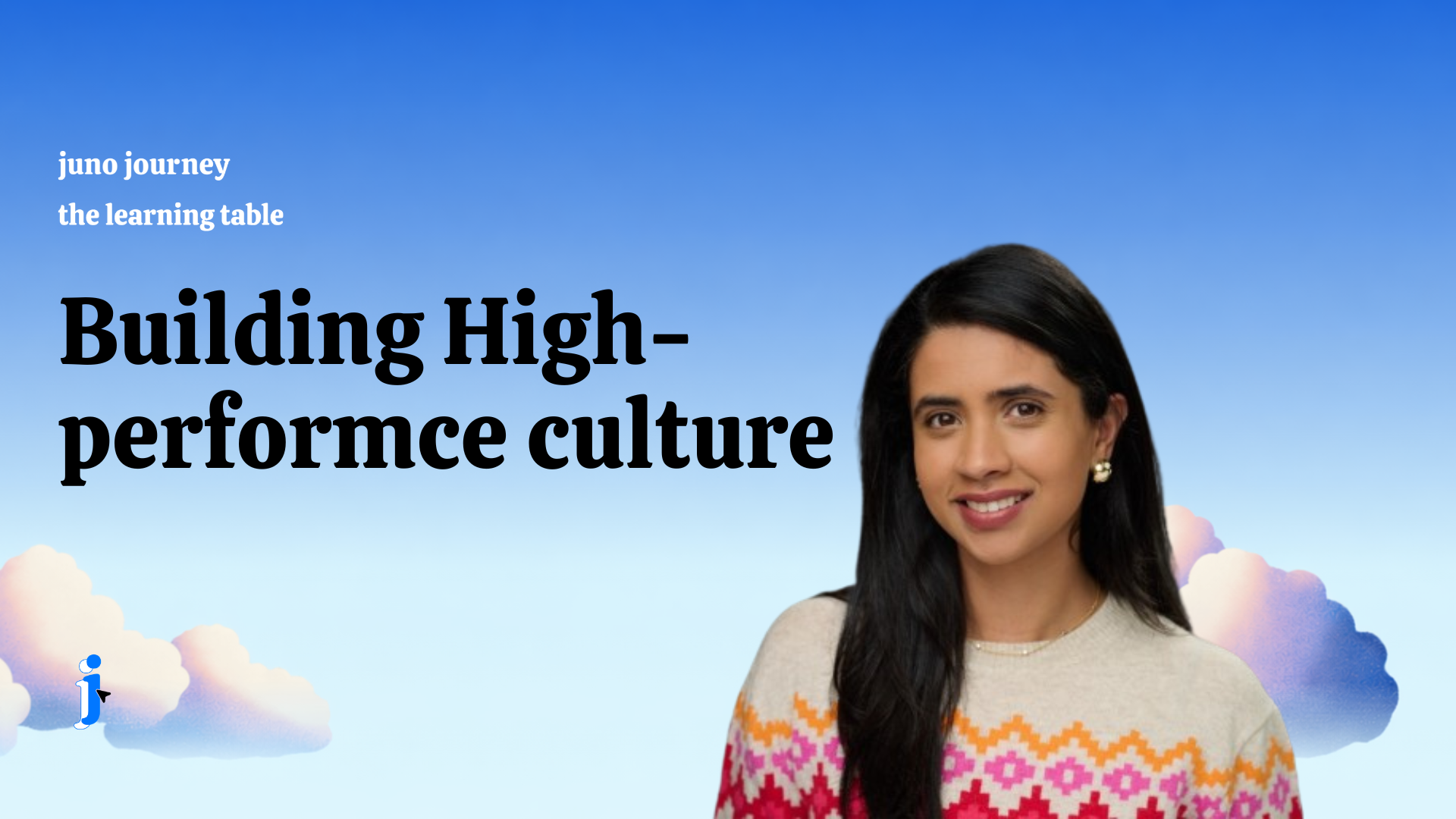
ICYMI: Building high-performance culture
Challenge Accepted series
August 19th, 2026 | Hosted by Klil Nevo, Juno Journey
Expert: Ana Monga, Google
ICYMI: Building High-Performance Cultures: What HR & L&D Leaders Need to Rethink
What actually creates a high-performance culture?
Not more performance reviews. Not hiring a collection of “superstars.” And definitely not tracking mouse clicks, badge-ins, or whether someone has a green dot next to their name.
In our latest Learning Table session, we sat down with Ana Monga, a global HR leader with 15+ years of experience across Google, Twitter, and PepsiCo, who today leads HR product strategy for Talent Management at Google.
Drawing on her experiences across very different organizations, Ana shared a simple but important idea:
High performance isn't something you hire. It's something you intentionally design.
And in a world where AI is changing how work gets done at incredible speed, that design matters more than ever.
Ana broke high-performance culture into four interconnected pillars: purpose, accountability + autonomy, psychological safety, and continuous learning.
Here’s what that means for HR and L&D leaders.
1. Purpose has to reach all the way down to the individual
Early in her career at PepsiCo, Ana found herself responsible for HR across multiple locations while still in her mid-20s.
She knew PepsiCo's broader mission. But more importantly, she knew exactly how her own work connected to it.
Years later, she could still recall the company's "Performance with Purpose" North Star without hesitation.
That wasn't an accident.
Ana described an organization where employees — from corporate headquarters to an 85-person warehouse — understood their responsibilities and how their contribution connected to broader business outcomes.
That's where purpose becomes powerful.
It isn't enough for the company to have a mission statement. Employees need to understand:
What are we trying to achieve? What am I responsible for? And how does my work contribute to it?
For HR and L&D, that means development can't live separately from the business. Learning, goals, skills, and career development need to connect people to what the organization is actually trying to accomplish.
2. Accountability without autonomy isn't high performance
Ana called the second pillar the "trust loop."
The idea is simple:
If you make it crystal clear what someone needs to deliver, you also have to give them enough freedom to determine how they'll deliver it.
At PepsiCo, Ana might have needed to run a 5 AM meeting for one warehouse shift and a 10 PM meeting for another. She was accountable for getting the job done.
But nobody needed to monitor whether she took a nap in the middle of the day.
That's the distinction.
High-performance cultures don't confuse visibility with accountability.
They establish clear expectations and outcomes — and then trust capable adults to figure out the path.
And in the AI era, Ana argued, this becomes even more important.
Organizations are introducing tools, experimenting with new workflows, and trying to understand where AI creates genuine value. Leaders can't possibly have all the answers in advance.
Innovation therefore requires what Ana called radical trust: giving people room to experiment, fail, learn, and adapt.
For HR leaders, the challenge becomes designing systems that provide clarity without control.
3. Psychological safety isn't about being nice
Psychological safety has become one of those workplace terms we use so often that its meaning can become diluted.
Ana brought it back to what it actually enables: risk-taking, honesty, disagreement, and learning.
Psychological safety doesn't mean avoiding difficult conversations.
It means being able to say:
"I made a mistake."
"I disagree."
"I don't know."
"I think there's a better way."
...without fearing retaliation for saying it.
Ana contrasted an early experience at Twitter, where disclosing her difficulty hearing was met with frustration, with her first week at Google, where she saw a visually impaired colleague fully enabled to participate through both technology and the behavior of the team around him.
That difference matters because high performance isn't simply determined by putting brilliant people together.
As Google's Project Aristotle famously found, how people work together matters enormously — and psychological safety is a critical part of that equation.
You need people willing to challenge, contribute, experiment, and admit when something isn't working.
Especially now.
4. Continuous learning doesn't mean continuous courses
This may be the most important shift for L&D leaders.
When we think about learning, our instinct is often to think about programs, courses, webinars, content, and formal development experiences.
But Ana challenged the group to think much more broadly.
Some of the most valuable learning happens through:
- real work and stretch assignments
- coaching in the moment
- peer-to-peer conversations
- communities and cohorts
- solving real business problems together
- frequent feedback
Ana shared how Google uses cohort-based experiences that bring leaders together around actual challenges they are facing. Rather than simply teaching content, the group becomes a "brain trust" for solving real problems.
People often discover that someone in a completely different part of the business is tackling a surprisingly similar challenge — and that frameworks and approaches can transfer across teams.
That's a very different model from:
"Your role requires these 12 courses. Complete them by Friday."
The question for L&D becomes less:
What should this employee learn?
And more:
What does this employee need to be able to do — and what experiences, feedback, practice, peers, knowledge, or support will help them do it?
That's the shift from course-based learning to capability building.
5. Feedback should be part of work, not an event that happens once a year
One of the most practical discussions in the session centered on feedback.
Ana challenged the traditional annual performance review model because feedback delivered months after something happened is inherently backward-looking.
Continuous feedback can be forward-looking.
And "continuous" doesn't have to mean another giant HR process.
It can simply mean making feedback a natural part of weekly or biweekly one-on-ones.
One participant shared an especially simple framework used with his team:
I like.
I wish.
I hope.
I wonder.
Employees don't need to complete every sentence every week. The prompts simply create a recurring opportunity to surface praise, concerns, hopes, and questions.
Ana also shared a personal example.
After she came across too strongly in a team meeting, a trusted peer messaged her just minutes later and asked for a two-minute conversation. The feedback was immediate, direct, and welcomed because psychological safety already existed between them.
No form.
No performance cycle.
No elaborate training program.
Just learning happening inside the work itself.
And that's perhaps one of the biggest opportunities for L&D.
Instead of only asking how to create more learning, start asking:
How can we make everyday work more developmental?
AI adds another interesting layer here. Ana pointed to AI coaching as an opportunity to give employees and managers more personalized spaces to practice difficult conversations, develop skills, and prepare to give constructive feedback.
Technology can support the process.
But the goal remains fundamentally human.
High performance is a system, not a collection of high performers
Ana closed the session with a definition worth remembering:
A high-performance culture isn't a collection of individual superstars with impressive resumes.
It's an intentional system.
A system where:
Purpose gives people a North Star.
Accountability + autonomy create trust and ownership.
Psychological safety makes it possible to take risks, disagree, and learn.
And continuous learning helps people keep growing as the environment changes.
For HR and L&D leaders, that's an important reframing.
Our job isn't simply to provide more training or build better performance processes.
It's to create the conditions in which people can understand what's expected of them, build the capabilities they need through real work, receive feedback quickly, experiment safely, and keep adapting.
Because as AI changes the tools, workflows, and even roles around us, Ana left the group with a reminder that feels especially relevant:
Our ultimate competitive advantage is still our humanity.
The organizations that perform best won't simply be those with the most AI or the smartest individual talent.
They'll be the ones that intentionally build cultures where people are trusted, empowered, supported — and continuously able to get better.